Showing posts with label jim clark. Show all posts

Monday, April 07, 2008

JIM CLARK 1936-1968

40 years ago today, Jim Clark, the best racing driver I have ever seen, was killed.

I've written about him before on this blog, but this day needs my attempt at a tribute.

Was he the best? The truthful answer is – you decide. It is simply impossible to judge the best from one era against the best from another era. Especially in such an arena as Motor Racing, where the changes in technology make such utterly different demands on those who drive the cars. Jackie Stewart, himself a three times World Champion, and one who I suspect believes himself to have been a better driver than he is usually given credit for, sums it up by saying that all you can do is beat those around you when you're involved. And of course he's right. But, it's also the WAY you do it, sometimes quite a mercurial attribute, which puts some champions above the others. But when it's there, it is most definitely there.

In the Sixties, racing a Formula 1 car was a fearsomely dangerous activity. That's not, in any way, to demean those who do it today, but the cars then had minimal safety protection, they were not built with anything like the technical know-how used today, the drivers wore precious little to help them in the event of a crash, there were at best next to no, and at worst no safety services at the races, and the circuits went almost totally unprotected. A run-off area was just as likely to be a forest as a brick wall.

If you had an accident, it was likely to be a big one. Innes Ireland, ex fighter pilot and Lotus driver before Jim Clark, writes very eloquently when he says he left his hotel room on the morning of a race, and looked around, not knowing if he would see it again.

That pressure alone places a totally different mental demand on the driver, and yet they still queued up to do it. The picture below sums it up. Taken at Spa in Belgium, a long, sweeping, fast and dangerous circuit which swooped through the Ardennes forest, the strain of racing shows in his face. The first time he raced there, his team-mate, Alan Stacey, was killed as was another driver, Chris Bristow. Clark came to hate the place yet he still won it four times in succession. That’s courage, as well as supreme skill.
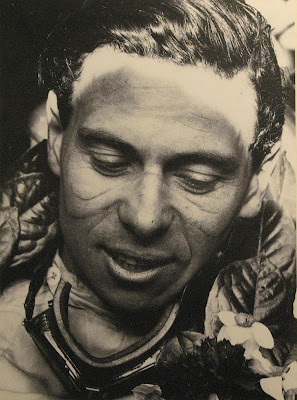
THE STRAIN OF IT ALL

Denis Jenkinson, the best Motor Racing journalist ever, had his own typical forthright view. “Forget the World Championship, just give it to the man who wins at Spa”.

There is an argument that the whole Formula 1 game was not as competitive as it is today, and it's probably true. The rules governing the car's design allowed the shaft of engineering genius to shine through far more than today. But, at the top, the competitiveness was there, be in no doubt. It's just that there were probably 20 people in a racing team rather than the 200+ today. Today it's Toyota, Renault, Mercedes, BMW, Honda, Fiat – then all the teams survived on their racing wits, with no "Big Manufacturer" standing behind them as a safety net.

An elder statesman of the Motor Racing Journalist group has just thrown his hat in the ring and put the cat among the pigeons by writing a book called "Alan Henry's Top 100 Formula 1 Drivers". He has been present at around 600 of the 700 Grand Prix races ever held, and his rankings make excellent reading.

He places young M Schumacher at Number 11.

I can't recall a book on the subject which has got the Motor Racing Blogging fraternity jibbering and foaming at the mouth so much as this list, which after all is just an experienced journalist's view, after a lifetime of watching races. He's not right, just sharing his thoughts with us all.

To him, it is not just points scored which secure your place. Otherwise it would be M Schumacher way ahead of everyone else. His view is much wider – the individual, how he acts, how he drives, the cars he drives, and a much more subtle range of almost emotional issues come into play.

He placed Jim Clark as No. 2 on his all-time list, with Stirling Moss at No.1. I imagine Moss got the nod because Henry thought Clark more often had the best car in the field, whereas Moss indubitably did not. I don’t agree with his order, but so what?

Just to get the statistics on the table, once he had won his first Grand Prix, Clark took part in 56 more Grand Prix races. Reliability then was much more of a lottery than now, and of those 56, he retired from 19, leaving 37 races which he finished. Of those 37, he won 25. That’s 2 out of every 3. He came 2nd only once. For a lot of the time, his team-mate was not a Schumacher style “Rear Gunner” – it was Graham Hill, himself a World Champion. I can’t actually be bothered to check out the whole of Grand Prix History, because I can’t think of anyone with a record remotely like that.

Clark was a strange man. He was born into Scottish Borders farming, and although he undoubtedly changed as his Motor racing life took him over, you felt he never lost sight of this background – as far removed from a Grand Prix driver as you could imagine. He seemed to be an introverted, manically nail chewing, almost reticent individual out of a car. Inside one, he was hard, disciplined, sensitive, the smoothest of the smooth drivers, and supremely fast.

He was a Pole Position specialist, and his racing style was simply to blast away at the start, immediately get a dominant lead, and leave the remainder of the field to fight for Second place.

The sixties were also times when there was no such thing as a Grand Prix Driver. They drove everything. Clark raced large American saloons, Formula 2 cars, Indianapolis Speeedway, Sports Racing cars, Le Mans, “David and Goliath” Lotus Cortinas (see below for a picture which shows what that involved!), as well as taking part in the 1966 RAC Rally.

NOW THIS IS RACING! - CLARK IN A LOTUS-CORTINA


It was this dichotomy between the type of man he was off the race track, and the man whose driving defined the racing era he lived it which has been the source of so much fascination. Most of his peers put him in a different class from the rest, and they should know.

Chris Amon (No 13 on Alan Henry’s list), summed up what Clark’s loss meant - "If this can happen to Jimmy, what chance do the rest of us have? I think we all felt that. It seemed like we'd lost our leader."


Photographs borrowed from Eric Dymock - Jim Clark Racing Legend

Tags:

,
,
,,

Monday, April 16, 2007

FORD F3L - MY CAR

I penned a piece a few days ago about Jim Hall, the driving force behind the amazing Chaparral Sports racing cars in the late 60s, and it got me thinking again about the idea of the “Art of the Racing Car”. I am not really sure where the idea of “Beauty” stands in relation to such a violent piece of machinery. You could take a view that “Beauty is in the eye of the beholder”, or you could take a view that Function is the sole requirement of a car which simply tries to go round a circuit quicker than any other. The idea that if it does what it’s supposed to do better than any of the others, that makes it beautiful.

Personally, if you ask me to choose between the two, the answer is “Yes”. Both.

The designer can draw a car which satisfies my idea of aesthetic beauty. Look at the Gurney-Weslake Eagle and you will get a flavour of what I mean – its nose mimicking an eagle’s beak, the quite exquisite detailing on the chassis. If you ever get a chance to see one in the flesh, just look, for instance, at the fuel filler cap - it could win a design prize on its own.

But you can also build a car, which, simply because of its outrageous performance, is beautiful in another way. Look back at the Chaparral 2K Model which Jim Hall produced in 1970. It actually looked as if the front half of the car, and the back half, had been designed by two different teams of engineers who didn’t meet very often. But, judging it on the Function argument, it was a real beauty.

This piece is about a car which I think takes a lot of beating in the real “Whow, just look at that” Beauty category – the Ford F3L 3 litre sports racer (or P68 to give it its official designation).

It was produced very quickly following the end of the old Sportscar formula in 1967. Ford had just produced one of the greatest racing creations ever with the launch of the DFV V8 engine, and this was mopping up Formula 1 in an utterly dominating way. As a result, some bright spark had the brainwave that here was JUST the engine to power a Prototype sports-car for the new formula, which could blow all the other new cars into the middle distance.

Alan Mann Racing, with “a little help from their friends” designed and built the P68 machine which emerged just in time for two of them to enter the BOAC 500 Mile Endurance race at Brands Hatch in April 1968.

Now here I must “declare an interest”. At this time, I was studying Aeronautical Engineering at Imperial College in London, and in the final year, every student undertook a large “rites of passage” type of project or dissertation. Given my fascination with Things Vehicular, I chose to investigate “Motor Vehicle Aerodynamics”. As part of my practical work, by means still not clear to me, I obtained a 1/6 scale model of a new sports racing car then under development, and was given this to test in one of the colleges many Wind Tunnels.

I’m sure you will see where this is all leading. The model I was testing turned out to be the P68, and I spent many happy hours looking at its drag and lift characteristics. As you can imagine, it became “my” car – I had played a small part in its development, and for a 20 year old, that really meant something.

PICTURES TAKEN IN 1967 IN IMPERIAL COLLEGE WIND TUNNEL OF MODEL ON TEST


When it was finally announced in the Press, the finished article simply took my breath away. Its feline, almost feminine grace was something I had never seen before in a racing car. To me, it was the most beautiful racing machine I’d ever seen, although perhaps, I was a tad biased!

And when it was clear that it was finally going to race, I shot down to Brands Hatch, to will it on. The rest of the story that day was a simple, unmitigated disaster. The plan apparently had been for one of the pairs of drivers to be Graham Hill and Jim Clark, but contractual commitments and obligations had intervened, and they went off to Hockenheim to race there. They were replaced by Bruce McLaren and Mike Spence. In the event, one of the two cars didn’t start, but the McLaren/Spence car was second on the grid.

As happened so often in those days, the cars had hardly turned a wheel, before being committed to the track. Sometimes it works – just read the debut of the Lotus 49 at Zandvoort the previous year – but most of the time, it doesn’t. And it didn’t at Brands Hatch that day. After, I think, a bit less than an hour, it stopped with a broken drive coupling. Bummer.

THE REAL THING - TAKEN AT BRANDS HATCH ON APRIL 7 1968

It was only after the event that the real catastrophe of the day became clear. Driving up the hill out of the circuit, I turned on the 6 o’clock news to hear the newsreader report that Jim Clark had been killed that afternoon at Hockenheim.

To me, Jim Clark was, and still is, the best driver I have ever seen in a car. His ultra smooth, calm, undemonstrative style of driving was so at odds with the speed he could produce. He was literally in a class of his own, and so much better than anyone else around him. And to hear that he had been killed in an inconsequential little race in the middle of Germany, when he should have been here at Brands Hatch, driving “my” car, and still been alive, was too much to bear. I remember pulling off the road, and sobbing my heart out.

After that day, Formula One ceased to be a passion. The price you sometimes paid was simply too high.

Tags:


,
,,
,
,,
,
,

Saturday, September 16, 2006

HOW, OR HOW MANY?

My first attempts at punditry on this site last week, suggesting that Michael Schumacher would drive competitively in 2007, and that Tony Blair would try to last out as PM until 2008, have both crashed violently in flames over the last few days. So, Played 2, Lost 2 – not a great start. No doubt the “Blaircrash” will return to haunt us here, but let’s think now about our German friend.

Schumacher has decided that he has had enough. It’s probable that he will clinch his 8th World Championship this year - a quite remarkable achievement. But does that make him the best driver ever? That’s a very different question.

In cold statistics, at first his figures make everyone else seem like also-rans. He could end up winning 93 Grand Prix, with the next highest being Alain Prost on 51. He has scored 1,248 points so far in his career, with the next best being less than 800. And so on, and on. But there are other ways of looking at numbers, and there is a much bigger issue about not just How Many, but How?

How important is it in any sporting arena to balance the actual achievement, with how it was all done? Are the figures in the record books the sole judge of greatness, or at the highest level, is it a more subtle combination of the individual’s attitude, moral approach and style as well as the cold numbers?

There is no right answer, although I lean very heavily towards the combination of How and How Many. On the one hand. there is little doubt that for anyone to be considered great, they must have an excellent record of success just to get on the board. Try to think of one individual who you would consider to be The Greatest in any sporting field, with a limited or minimal level of success in the record books, and you’ve got a real argument on your hands to convince the world you’re right. So you do need the numbers.

The real Greatests, the Mohammed Ali’s, the Sampras’s, the Navratilova’s, the Lance Armstrong’s all have the numbers in the book. But they have something else, as well. And this is where the Schumacher debate gets interesting. I scribbled a piece the other day called "Michael Schumacher – Flawed Genius". He undoubtedly can drive a Grand Prix car better than anyone else today, and has been able to do that for 10 years. He has stamped his authority on the sport like a vice. He has taken the physical and mental conditioning of the Driver to new heights, he has forged a team around himself at Ferrari in a way no-one has ever done before – all prodigious Firsts.

And yet, there’s always a But with the man. Insiders keep telling us that he’s a really warm hearted individual away from the circuit, how he loves his kids and family. From The Greatest’s point of view, those things are not that important. It’s the conduct “on the field” that matters. The fact that, in his professional career, he has been guilty of several underhand and quite dirty actions, of which most drivers would be rightly ashamed, is enough, in my view, to push him off the top rank of drivers who could be seen as The Greatest - in spite of his record. You just don’t do those things. It’s as simple as that.

So, who is the Greatest? There has been much ink spent this week, ruminating on Schumi’s retirement, and the list of names which comes up time and time again, is very small. It contains Schumacher, and the only others are Fangio, Senna and Clark. And that’s it.

Interestingly, Alain Prost, with the 2nd highest total of 51 wins, never gets a mention. So that’s one good argument to prove that it’s not just the numbers. He was a good driver, nicknamed “The Professor”, but you’d never get out of bed to watch him race, whereas the other three, well, that’s the last thing you’d say about them.

Senna, because of his death, has become almost immortalised by the media. You don’t have to look too far however to see some of Schumacher’s Win at all Costs approach in the way Senna raced. One of life’s “What Ifs” is Senna vs Schumacher. Senna was killed just as Schumacher got into gear, and I actually think Senna had already seen how good Schumacher was, and that may have had an effect on the way he drove in 1994.

Sometimes, you could be forgiven for thinking that the racing car has become so safe these days, that forcing an accident has become a deliberate tactic and fair game to drivers over the last 20 years. The other guy nowadays will likely be forced off the track onto an acre of gravel, and – so what? In the 50s, 60s and 70s, such actions could easily kill you opponent, so you treated such actions with a totally different level of seriousness. It’s the sort of issue which actually means comparing champions from different eras is almost impossible. Jackie Stewart, himself a 3 times World Champion, was asked to make such a comparison, and parried it quite simply with “All I could do was to beat the guys around me at the time.” Which he did.

I think in areas such as this, with no real right answer, you are affected by a raft of other side issues, one of which is your own age. I think that the things which impact on you when you are at your most impressionable, around 18-25, take on an almost over-riding importance which lasts all your life. I know it did with me. Music and Musicians, Writers, Films, Actors, Singers, sportsmen and women, and I suppose, friends and people in general, drill into you very deeply at that age.

I missed seeing Fangio in those years, and if you read his life-story, he gets many people’s shout, including people like Stirling Moss and Murray Walker, but look at when they were both 18-25. See what I mean? But I still put him at Number 2 - just.

It will not come as a surprise then, that my Greatest Driver EVER is Jim Clark. I was loopily passionate about Motor Racing in my adolescent years, and Clark was in a completely different class from all the others for all that time. If you look at the cold numbers, compared to more recent drivers, there are very few categories where he now comes top. He won, ONLY, 25 races, and scored, ONLY, 274 points and so on. But, with statistics, you need to look a bit deeper to see the reality. He ONLY started 74 races, and because car reliability was nothing like it is today, he only finished 40. Starting with that number, winning 25, including all his days as a driver starting out, takes on a whole new meaning. He NEVER finished second. In fact, you could say, that if his car was running sensibly and well at the end of a race, he would win. Simple as that.

It must have driven his team-mates mad. It wasn’t like Schumacher, who has always ensured that his team-mate is more like a domestique in a Cycle race – there solely to support himself. Clark spent a good part of his career with Graham Hill as his team-mate, and Hill was already a World Champion, so it was a case there of Fastest Man wins in the Lotus team.

As an example, Clark drove what many people, including myself, think is the finest race ever, at the 1967 Italian Grand Prix. Monza, in those days was a mad rush with no chicanes to slow you down. A third of the way through the race, Clark was in the leading gaggle of cars, but suffered a puncture. He lost more than 1 lap while the tyre was being changed, and we then saw just what a racing driver can really do. He drove at his maximum for the rest of the race, starting back in 16th place, firstly unlapping himself, and just before the end of the race he had caught up the whole lap on everyone, including his team-mate. He passed them all and took the lead. Coming down the final straight, his car faltered, and ran out of fuel. He coasted round the last corner and finished 3rd.

It was the only time he was seen to get angry, having driven the race of his life, and then been thwarted in victory, for the want of a cupful of petrol.

He was as unassuming a man as you could imagine, being a sheepfarmer from the Scottish Borders. He could drive anything, literally anything, and his David and Goliath exploits in a tiny Lotus Cortina up against huge American Ford Galaxies is the stuff of legend. His car only ever seemed be on three wheels, and if he was trying really hard, on two – you wouldn’t have believed it had you not been there. You thought he was there for ever, so good was he, but…..

In the cruel way of the sport in those days, he was killed in April next year, in an inconsequential Formula 2 race in Germany, and for me, and I suspect many other people, the passion for the sport died with him.