Friday, April 20, 2007

CREATIVE FREEDOM,OR "FIDDLING ABOUT" - YOU CHOOSE

My regular reader will have noticed, by now, my penchant for things Photographic. I suspect I am a frustrated artist, who, having tried and failed quite stunningly at drawing and painting, has taken up photography as a way to make some positive, personal progress in the Visual Arts.

Sprinkled through the various pieces on this Blog, you will find examples of my own personal photographic efforts. They sit alongside, although actually the word is most certainly “underneath”, the works of the great picture takers of all time.

As part of my interest, I belong to a local Photographic Society, where, at various times during our Meeting season, we are invaded by a Judge, who, comes along, looks at the Member’s pictures, critiques them, sometimes critically, sometimes constructively, and then picks the Best Picture of the night. Which is, of course, really means the Best Picture of the Night, in his opinion.

And, in the same way that football fans clearly like to disembowel the referee after a match which their team has just lost, the Club Members like to do the same with "The Judge" in the pub after such an evening – apart from the one guy whose pictures have just been selected by "The Judge" as The Best!

To make my position clear, I have decided that I am now officially Old Enough and Ugly Enough to contemplate Life carrying on, even when our Photographic God for the evening has suddenly fallen completely blind, taken complete leave of his senses and not selected my photographs as the best that night, when it was clearly obvious to the meanest intellect that there was only one true genius in the room. So the opinion of "The Judge" is now less important than once it might have been.

Now, on slightly another track, I give the occasional lecture to other Photographic Societies where I review Photography and its impact and influence on the World since its invention in the 1820’s. The great “photographic lurches forward” of 1- its Invention, 2- Kodak’s Bringing it to the Masses, 3 - The Invention of the small portable Leica-type camera and fast film, 4 - The Invention of the Colour film, are the first 4 Chapters in the Development of Photography over the last 180 years, but the latest “lurch”, where we are still in the midst of it, is the Digital Revolution.

Film is on its last legs, and the impact of the Digital Image is well in the throes of totally transforming the way pictorial images are being taken, distributed and used. Here I am writing in a digital form, showing you digital images, and if you look around the world, almost all images that you see are created and distributed via Digital means.
Almost the last bastion of the “analogue”, film image is the Photographic Society, of which there are many hundreds in this country alone. And The Judge who comes to adjudicate on our Member’s images is, more often than not, a skilled “film” worker, rather than a digitally based individual.

There is absolutely no doubt in my mind that a well produced, usually Black and White Print, often produced after many hours of hugely skilled work in a Darkroom, is a most remarkable piece of work. I simply do not have these skills, and admire those that have enormously. And when we see one of these pictures being judged or critiqued, sometimes you feel quite humble when realising the skill which is involved in the final image.

But there is another side now – the ability to do the most amazing, creative things with an image, using Computer programmes, which allow an almost “Sky’s the Limit” approach to be applied between the original shot, and the image finally shown. This, in my humble opinion, should also be given its true weight.

All too frequently, The Judge, will look at a “Digital” image, and in a “damning with faint praise” style, see the changes wrought on the original image as “fiddling”, and to some extent, destroying the integrity of the original. Now, to my simple mind, the efforts of the person slaving over a hot keyboard using “Photoshop”, is identical to the darkroom worker, slaving over a hot Chemical Set. They are both trying to generate something artistic from a start-point of a basic image the photographer has taken. I see no difference philosophically between the two approaches – they are both Means towards Ends, and you should judge the final image, and not place the Darkroom Worker on a pedestal, whilst demeaning the “Photoshop” Fiddler who, by different means, has created the same thing – a personal work of Art.

The really exciting thing is that this new form of Creative Expression has become available in our lifetime. I welcome it with open arms, and get more than a bit cheesed off with those who see it as the work of the Devil. To me, it has allowed so much more personal input to be made into a photograph, where the aim of it all is to affect the emotions of others. You can now behave far more like a painter, where the constraints of the camera, and “The Image cannot Lie” approach has been so restrictive for so long. Even the phrase “The Camera cannot Lie” gives you a clue as to the restraint which photographic film has had on its users.

Now if, when taking a landscape, where there is, say, a telegraph pole in a landscape I’m taking, I can eliminate it, just like a painter might do, and produce, what to me, is a better result, or at least the result I want. In addition, there is a huge range of digital adjustments which can now be made, some of which mimic what’s achievable in the darkroom, and some of which do not. The simple result is that the User’s mind is freed up to “fly” in a way which simply wasn’t possible few years ago.

Why you’d ever want to push this amazing capability away is beyond me, but there are still some people who do not look on it favourably. I do think very much that it is a capability which needs to be used sparingly – “Less is More” is not a bad mantra to keep repeating to yourself when sitting in front of the Computer screen, but there are undoubtedly many areas where such post image manipulation can add something unique. It’s a bit like comparing the representational painting of someone like Canaletto with the paintings of Monet – both are magnificent, but, in spite of their differences, both have their place in the Visual Arts.

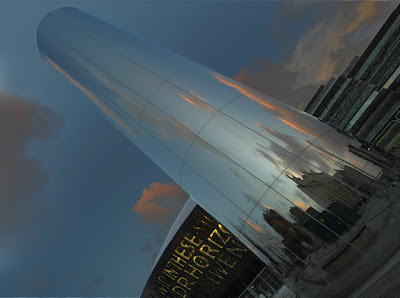
All of which is a much longer, rambling introduction than I had envisaged, to a set of four images which I took on a fleeting visit to Cardiff recently.

Cardiff has undergone a major transformation recently, and the new Civic Buildings there are clearly designed to put the city on the architectural map. The exterior of the concert hall is clearly aimed at reflecting the “Slate” image of the country, in the same way that Scotland so often is seen as a “Granite” country. Now, I don’t think the buildings there are of a quality where you come away saying “You’ll never believe the building I’ve just seen”. Not in the way you do after seeing such buildings as Richard Roger’s Lloyds Building (now 21 years old!), the Gehry Guggenheim Museum in Bilbao or even, much closer to home and more prosaically, the new Selfridges in Birmingham

But they are new, distinctive and impressive. And because of the forward looking thoughts that creating new buildings such as these produce, I decided to play around with Photoshop to show images which had a bit more modern creativeness about them. That doesn’t mean you will necessarily like them, it just means that I’ve “fiddled” about with them a bit more than I would normally do.


Tags:


,
,

Thursday, April 19, 2007

WHAT'S A DEATH WORTH, IN FOOTBALL TERMS?

My current choice of a newspaper, and it has been this way for many years, is “The Times”. But when I look at the front page today, I wonder if we’ve all gone just a bit mad, and shouldn't I think about a change.

Judging the importance of news by column inch “real estate” on the paper’s front page, the reaction to the Virginia Tech Massacre, which claimed 32 lives, took up (albeit including a large photograph of a British teacher who apparently had warned the police about Cho Seung Hui two years ago) 24 column centimetres.

Among the lesser stories which were brought to our attention was a 38 word long summary (about 2 Column Centimetres) which explained how Arsenal football club was in “turmoil” after its Vice-Chairman had suddenly left the club yesterday.

And just underneath this story was one of the same length which told us that Four bombs had exploded in Baghdad yesterday, killing “nearly 200 people”.

When you follow up these stories inside the paper, you find that the Virginia Tech story is given a further 3¾ full pages, the Arsenal story merits (if that is the right word) around a further 3 full pages, and the story about how “nearly 200 people" were blown to bits in a city I thought we, and the Americans, were supposed to be safeguarding, is given another 2/3 of a page, plus an article commenting on the issue, by Bronwen Maddox.

I’m not even going to bother to work out and compare the Column Centimetres per death figures for the American and the Iraqi disaster, other than to guess that a factor of 10 or more is probably involved.

The really depressing thing to me here, is that the managerial goings on at an English Football club are deemed to be about six times more important to “The Times” that the bloody dismembering of nearly 200 souls in Iraq.

“The more I see of the Human race, the more I love my dogs.” I don’t know who said that, but today, I’m with them.

Tags:

,
,
,

Monday, April 16, 2007

WELL ANYWAY, IT AMUSED ME - No.9

Taken in Newport, Gwent, showing the Town Council's latest Health and Safety inspired approach to Pedestrian control, next to (or rather in) the tidal River Wye.

You know it makes sense.

FORD F3L - MY CAR

I penned a piece a few days ago about Jim Hall, the driving force behind the amazing Chaparral Sports racing cars in the late 60s, and it got me thinking again about the idea of the “Art of the Racing Car”. I am not really sure where the idea of “Beauty” stands in relation to such a violent piece of machinery. You could take a view that “Beauty is in the eye of the beholder”, or you could take a view that Function is the sole requirement of a car which simply tries to go round a circuit quicker than any other. The idea that if it does what it’s supposed to do better than any of the others, that makes it beautiful.

Personally, if you ask me to choose between the two, the answer is “Yes”. Both.

The designer can draw a car which satisfies my idea of aesthetic beauty. Look at the Gurney-Weslake Eagle and you will get a flavour of what I mean – its nose mimicking an eagle’s beak, the quite exquisite detailing on the chassis. If you ever get a chance to see one in the flesh, just look, for instance, at the fuel filler cap - it could win a design prize on its own.

But you can also build a car, which, simply because of its outrageous performance, is beautiful in another way. Look back at the Chaparral 2K Model which Jim Hall produced in 1970. It actually looked as if the front half of the car, and the back half, had been designed by two different teams of engineers who didn’t meet very often. But, judging it on the Function argument, it was a real beauty.

This piece is about a car which I think takes a lot of beating in the real “Whow, just look at that” Beauty category – the Ford F3L 3 litre sports racer (or P68 to give it its official designation).

It was produced very quickly following the end of the old Sportscar formula in 1967. Ford had just produced one of the greatest racing creations ever with the launch of the DFV V8 engine, and this was mopping up Formula 1 in an utterly dominating way. As a result, some bright spark had the brainwave that here was JUST the engine to power a Prototype sports-car for the new formula, which could blow all the other new cars into the middle distance.

Alan Mann Racing, with “a little help from their friends” designed and built the P68 machine which emerged just in time for two of them to enter the BOAC 500 Mile Endurance race at Brands Hatch in April 1968.

Now here I must “declare an interest”. At this time, I was studying Aeronautical Engineering at Imperial College in London, and in the final year, every student undertook a large “rites of passage” type of project or dissertation. Given my fascination with Things Vehicular, I chose to investigate “Motor Vehicle Aerodynamics”. As part of my practical work, by means still not clear to me, I obtained a 1/6 scale model of a new sports racing car then under development, and was given this to test in one of the colleges many Wind Tunnels.

I’m sure you will see where this is all leading. The model I was testing turned out to be the P68, and I spent many happy hours looking at its drag and lift characteristics. As you can imagine, it became “my” car – I had played a small part in its development, and for a 20 year old, that really meant something.

PICTURES TAKEN IN 1967 IN IMPERIAL COLLEGE WIND TUNNEL OF MODEL ON TEST


When it was finally announced in the Press, the finished article simply took my breath away. Its feline, almost feminine grace was something I had never seen before in a racing car. To me, it was the most beautiful racing machine I’d ever seen, although perhaps, I was a tad biased!

And when it was clear that it was finally going to race, I shot down to Brands Hatch, to will it on. The rest of the story that day was a simple, unmitigated disaster. The plan apparently had been for one of the pairs of drivers to be Graham Hill and Jim Clark, but contractual commitments and obligations had intervened, and they went off to Hockenheim to race there. They were replaced by Bruce McLaren and Mike Spence. In the event, one of the two cars didn’t start, but the McLaren/Spence car was second on the grid.

As happened so often in those days, the cars had hardly turned a wheel, before being committed to the track. Sometimes it works – just read the debut of the Lotus 49 at Zandvoort the previous year – but most of the time, it doesn’t. And it didn’t at Brands Hatch that day. After, I think, a bit less than an hour, it stopped with a broken drive coupling. Bummer.

THE REAL THING - TAKEN AT BRANDS HATCH ON APRIL 7 1968

It was only after the event that the real catastrophe of the day became clear. Driving up the hill out of the circuit, I turned on the 6 o’clock news to hear the newsreader report that Jim Clark had been killed that afternoon at Hockenheim.

To me, Jim Clark was, and still is, the best driver I have ever seen in a car. His ultra smooth, calm, undemonstrative style of driving was so at odds with the speed he could produce. He was literally in a class of his own, and so much better than anyone else around him. And to hear that he had been killed in an inconsequential little race in the middle of Germany, when he should have been here at Brands Hatch, driving “my” car, and still been alive, was too much to bear. I remember pulling off the road, and sobbing my heart out.

After that day, Formula One ceased to be a passion. The price you sometimes paid was simply too high.

Tags:


,
,,
,
,,
,
,

WELL ANYWAY, IT AMUSED ME - No.8

The Marketing edge - Shropshire style!


Tags:
,
,

Saturday, April 14, 2007

"LET THEM EAT BREAD" - 'COS I'VE JUST MADE IT

“Cogito, ergo sum: Cogito, Dim Sum.” Latin for “I think therefore I am: I am what I eat.” Or something like that.

Yet another of the reports which constantly analyses us all to death tells us that the average person’s arsenal of recipes which they can cook is around five. Now assuming that, on the male side, there still remains a hard core of the “Get me dinner on the table, woman” type, who presumably do not trouble the scorers in such a review, that must mean for those interested in foody matters, the average is somewhat higher.

This is quite surprising as in my youth, in the 50s, cooking in my parent’s house was more like a refuelling operation, rather than something to nibble seductively away at one’s tastebuds. I suppose one of the major causes for this change, in addition to the explosion in foreign travel which has opened our eyes to the sight, smell and taste of cookery from other countries, has been the rise of the celebrity chef. Just after the Second World War, my mother had Mrs Beeton to guide her as well as the Good Housekeeping recipe books, but much of the cooking on which I grew up veered towards Woolton Pie* rather than Omelette Arnold Bennett.

Just around that time, Elizabeth David’s books appeared, and, over the next few decades, the trickle of cookery books gradually turned into a complete flood. TV picked up this theme, with Robert Harbin, Fanny Craddock (I seem to recall her once concluding a recipe with the phrase “Enough for one large Tart” – cheeky Bag!), The Galloping Gourmet, Keith Floyd, Delia, Nigella, Rick Stein, Jamie Oliver, Gordon Ramsay and now Heston Blumenthal have been educating us all for nearly 50 years, with television doing what it normally does and distorting almost all of them into strange “personalities”, to keep the programme ratings on the boil.

For someone who has only turned his hand to cookery over the last few years, it has been fascinating to watch this motley crew retrospectively in action on the innumerable cookery “GastroPorn” channels on television. I’m not sure how much you really learn from watching many of the showbiz antics of some of them, but it is always intriguing to put the visuals away, and look at or try what they are really there for – their recipes. If I’d tried everything they cooked, I’d be the size of a small town by now, so I’ve only had a go at a small selection of what’s on offer from them.

The strange thing is, there are some chefs you see where I hardly fancy anything they put in front of us, whereas there are others whose offerings almost always get me salivating. This applies not just to the cookery programmes, but the books that they all write as well.

Garry Rhodes, Ainsley Harriet and AWT, I simply can’t hit it off with. Heston Blumenthal seems to live in a parallel universe to the one I inhabit, and I simply don’t warm to his cookery at all. I love Rick Stein, and, like most men, have this dark hankering for Ms Lawson to come round and show me how to cook just about anything. I admire Saint Delia, and Christmas in this house has mainlined on the good lady’s recipes for many years now. I can take or leave the rest, apart for Gordon Ramsay, whose recipes in The Times, I always seem to be cutting out with an “Ooh, I fancy that!” comment.

But there’s one guy who tops the lot for me. In terms of TV, he’s probably one of the least good, but, read his cookery books, and then try his recipes, and that’s the reason I’m a total fan.

Nigel Slater.

His writing is, by a country mile, the best of the lot. He writes in a language as if he’s sitting across the table, discussing a particular dish, with a glass of wine in his hand. No pretension, no bullshit, and he makes the whole thing come to life in a way no other writer does for me.

He also seems to want to cook things which almost always gets me drooling, simply by reading the words on the page. None of this “First, skin one’s Ox…” approach. He cooks things that we all like to eat, but with a twist which makes it all a bit special. A eulogy to the Chip Butty, an excellent Toad, which includes wrapping Pancetta around the herby Pork Sausages, and cooking them all in a Mustard tweaked batter, and another on how to make “a really good, and very easy white loaf”. He uses quantities like “the handful, the pinch and the slurp”, and tries to make you “feel” what you are doing in the cooking, rather than slavishly following an “accurate to a gram” listing, which takes no account of the fact that tomatoes, say, change size, texture and taste as the seasons move on.

I’ve just made his bread recipe, and taken it down to tempt my daughter, son-in-law and my grandchildren, one of whom “does not like crusts”. Well, the whole, still warm, crisply crusted loaf seems to have simply disappeared, devoured with probably far too much butter – and Crusts now seem to be the order of the day!

ACTUALLY, MINE LOOKED LIKE THAT, BUT IT HAD BEEN CONSUMED BEFORE I'D GOT THE CAMERA OUT, SO I PINCHED THIS PICTURE FROM ONE OF HIS BOOKS!


Well, the best laid plans etc …… That’s buggered tomorrow’s breakfast for me, but there you go. But, if that’s not what home cooking is about, I’m missing the point. Double quantities next time.

Try his home made pizza, with a layer of Garlic butter, pound coin-thick slices of al-dente cooked Cold Charlotte potatoes, a good layer of fresh thyme leaves, half a dozen slices of Italian Pancetta Ham, topped of with a few handfuls of Taleggio Cheese, and baked in a hot oven for about 10 minutes. I’ve never tasted a better pizza. Simple, distinctive, and great to eat.

What more can you want from a cookery book?

Pick any of the books he has written – “Appetite”, “Real Food”, “The 30 Minute Cook”, and “The Kitchen Diaries” – and you will not be disappointed.

If I had to live with one person’s cook books for the rest of my life, without doubt it would be Nigel Slater’s.

* Woolton Pie – See:

http://www.homesweethomefront.co.uk/web_pages/hshf_recipe_woolton_pie_pg.htm

Tags:

,
,

SHREWSBURY - STREET NAMES THAT TELL A STORY

Why do we only seem to explore our local surroundings when visitors come to stay, and the need to do the tourist thing around the area cannot be put off. So it was a few days ago, when out grandchildren came to stay, and we felt that a bit of sight-seeing would be in order.

Without trying to sound like the local Tourist Board, Shrewsbury is a particularly attractive town – not in the self conscious style of places like Chester and Stratford (-upon-Avon, not E15), but in a quiet, rather unassuming but very satisfying and comfortable way.
JUST ONE OF THE MANY INTRIGUING BUILDINGS IN THE TOWN CENTRE
It has a real business life of its own, and benefits from being a good distance from any other similar sized town. In fact, you could say much the same of the rest of the string of towns which sit along the Welsh Marches – Whitchurch, Church Stretton, Ludlow, Leominster, Hereford, Gloucester, Monmouth, Hay-on Wye, and more. This separation gives them all a real purpose, and has allowed them to retain a distinctiveness and an individuality, which has not been swamped by the onwards march of standardisation which is such a curse in towns in Britain today.

Wandering round Shrewsbury on foot, for that is the only real way of appreciating it, you are struck by the 600 or so listed buildings, many of them black and white, timber framed constructions, as well as the narrow streets and alleyways, which criss-cross the town centre.

As just a taster to the town, the pictures below show not the buildings, but a selection of road names around the centre of the town. As a pointer and a shorthand guide to what has gone before, they are telling signs. Just imagine why these names are what they are, and imagine anyone today even thinking of naming a street anything like these.


Don’t even ask where the “Grope Lane” comes from. If you really want to know, just Google “shrewsbury street names”, and follow the money. If your mind is starting to think “It couldn’t possibly be anything as rude as that ….”, then you’re probably on the right trail! Sexual openness and permissiveness did not start with Christine Keeler, the Beatles, the Pill, Woodstock and the other trappings of the 60’s – it was there, in spades, many centuries ago.

The imprint of history is here, and long may it stay.


Tags:

,
,

Tuesday, April 10, 2007

IF THE MRSA DOESN'T GET YOU, THE PHONES WILL

I don’t know if you’ve been in Hospital recently, but, if you haven’t, believe me, it’s a stressful experience. Ignoring the fact that there’s a man with a very sharp knife waiting for you, and that to minimise your litigious potential to them, they insist on telling you that your chances of survival are of the same order as playing Russian Roulette with a 12 chambered revolver, and the fact that, as soon as you manage to get to sleep, they throw the lights on, Guantanamo Bay style, to wake you up, and feed you food that you’d think twice about giving to a pet you didn’t like much, there’s always the telephones.

When you settle into your bed, you are faced with a Startrek style screen, which you are told is your lifeline with the outside world. It has a personal TV screen, a phone, some games and probably a lot more which, because you're ill, you can’t be bothered to find out about. They inform you that you cannot use your mobile phone “because it interferes with the equipment on the ward” so you are condemned to use the phone on this screen, since they have eliminated the Ward's Public Pay Phone, for reasons you can probably work out for yourself.

A Company called Patientline runs these things, and it seems they have a vice-like grip throughout the NHS. They have apparently installed 75,000 of these in over 150 hospitals, and run the system like a military operation. In another of the hugely successful, good old New Labour/NHS computer projects we have come to love and admire, some seven years ago they won a contract to put these screens into Hospitals to integrate doctor’s access to computerised patient’s records, allow electronic meal ordering, electronic real-time drug prescription and ordering of patient X-rays, as well as providing patients with entertainment and telephone services.

You can probably guess the next bit – the medical IT side of the process is still not working, so there is little or no payment going from the NHS to Patientline to recoup their £160million investment, so the only way the company can recover its outlay and make money, is to soak the patient. And they are about to be pushed even further under water.

The costs for this service are about to be raised by 160% according to the Newspaper. The Government, bless their cotton socks, maintain that a lifeline from a patient’s family and friends outside “is a luxury, and should not be funded by the taxpayer.” So, guess who pays the costs?

If you ring in on a landline to find out if a patient is still with us, you will be charged 49p per minute in peak time to talk to them. A 3 minute call from a Mobile phone to one of these Patientline machines will cost the caller £2.37p, and if you are stupid enough to ring out from your Hospital bed to a UK landline using one of these machines, you will be charged 78p for a 3 minute call.

The real solution here seems simple. The Medicines and Healthcare products Regulatory Agency (MHRA) conducted tests on mobile phones a couple of years ago, and concluded that “Only 4% of (hospital) devices suffered interference from mobile phones at a distance of one metre, with less than 0.1% showing serious effects.” Why not get the manufacturers of the 0.1% of equipment with a problem, to modify it and screen it in such a way as to reduce the 0.1% to zero. Then, we could all use our mobile phones to our heart’s content, making a huge improvement to the patient’s well-being – or am I being silly in still thinking that that the patient is No.1 on a Hospital’s agenda? Or alternatively, tell us which particular makes of phone the Doctors and Consultants use as they go on their rounds, and we will all pick one of those when we next go to Carphone Warehouse for an upgrade.

A combination of these two fixes will sort the problem out just like that. The Government can then do a deal with Patientline to pay them the revenues they expected to get, and, had the Government managed to deliver the IT Project on time, would now be receiving (Pigs/Wings/Fly). The elegant result here would be that the people causing the problem would then face the pain of paying for their failure.

Except of course, it’s our money they’d be using.
Bugger.
Tags:
,,,

DELUSIONS OF GRANDEUR - DPM STYLE

Now, here’s a headline to scare you witless – “Prescott sees himself as an ambassador to the world”. It was in the Times yesterday, and I have the horrible feeling it was serious. The ex Ship’s Steward has obviously got himself hooked on the “good life” style of living that goes with the Office of Deputy Prime Minister, and is trying to carve himself out a continuing niche when Blair is off on his lecture tours, and he is out of a job. Clearly the prospect of the glittering nightlife of Kingston-upon-Hull has lost its magnetism for him.

He, apparently, wants to “continue his role as an international ambassador for Britain”. He seems to have taken it upon himself, since the revelations about his tawdry affair with his secretary, to rack up his Air Miles and visit as many countries as he can. According to his Private Office, he has visited 26 countries since the beginning of 2005, one of which is China. He is reported to be keen to continue his work with the China Task Force, of which he has been Chairman for the last three years. The Times mischievously reports that this post is in the gift of the Prime Minister, and their suggestion is that Gordon Brown may well seize upon this to “welcome the opportunity to keep him out of the country.” Smart move, Gordo baby.

He is even threatening to avoid a by-election in his home constituency, and wants to keep his place to the end of this Parliament. The only exception, we are told, is if he was to be offered a prominent international position, which would prevent him from sitting in Parliament, such as (wait for it), President of the World Bank.

I simply can’t think of anything to say at this point, so I’m going to hide.

Tags:
,,

BEEP BEEP - THE MAN'S A GENIUS

STOP PRESS - See additional post just added on Jim Hall - 29th December 2007
The word “genius” is much overused today. Even in something like Motor Racing, which attracts a lot of very clever people, there are not that many. Ask yourself to create a list of Racing Car Designers who are “geniuses”, and once you’ve written the name of Colin Chapman down, most people start to think for quite a while before they write another name.

If you’re old and wizened, you might also put down Ettore Bugatti, Gordon Murray, Adrian Newey and Enzo Ferrari – although I actually think you’d be wrong with Ferrari. And if you think current F1 is still Motor Racing, I’m damned if I’d know whose name you would think of today.

Most people would not have the name of James Ellis Hall on their list. If you have, you’ll know immediately what this piece is going to be about. If not, read on.

Next clue - if the name Chaparral strikes a chord, you’ll realise now who I’m talking about. If you’re still no wiser, and racing cars interest you, keep reading because, as a Designer of racing Cars, the man is a Genius.


JIM HALL IN 1966 - CHAPARRAL'S CREATOR

JIM HALL AT GOODWOOD IN 2004 - PICTURE TAKEN BY YOURS TRULY!

Hall is a larger than life Texan, who started life, with a little more money than the average man, looking to get involved in the family Oil business, when his parent were killed in an air crash. He studied Mechanical Engineering, and, in the late 50s was bitten very hard by the Motor Racing bug. Rather than acting like the spoiled child, he turned out to be very, very good at it, and moved through a series of Maseratis, Ferraris, and home converted Lister-Jaguars, into which he shoe-horned a large American V8.

He teamed up with a fellow competitor named Hap Sharp, and between them, and a few others, they created a new racetrack in the middle of Oil rich Texas, which they called Rattlesnake Raceway, named after some of the local residents. They both gradually became more and more serious about racing, progressively buying a wide range of modern European racing cars from Lotus and Cooper, and always seeming to come off second best in the deals. Having got increasingly fed up with never quite getting what they had ordered, they decided to build an all American Sports racing car which they would call the Chaparral, in a small factory next to the Raceway.

Hall was an extremely good driver, easily good enough to compete in the Formula 1 World Championship. He drove for the BRP team in 1963, although he soon realised that trying both to build a racing car in Texas, and to drive a Lotus 24 in Formula 1 events around the world was not going to work. So he went back home to concentrate on building his cars.

Over the next seven years, he, and a very small team of helpers, built a series of racing cars, the like of which had never been seen before, or since. In some ways, Colin Chapman was the only man who, single-handedly, did anything like the same. One of Chapman’s greatest skills was to develop some innovation which literally transformed, for all time, racing car design. He didn’t do this just once, he did it many times. For students of Lotus history, the numbers 18, 25, 49, 56, 78, 79 and 88 represent a Holy sequence of Formula 1 car designs. When each of these Lotus models wwere introduced to the despairing horde of fellow designers, they simply stood around and realised that their own lovingly and newly designed cars had, once again, just been consigned to the scrap heap. Hall had the same effect with his creations.

Hall’s credits, however, are not quite as numerous, but it happened at least half a dozen times in his career. but it's difficult to think of another individual whom you could mention in the same breath as Chapman. Indeed, I have a sneaking feeling that Chapman always took a great interest in what Chaparral were doing, and on a number of occasions, the “new” Lotus that Chapman launched onto the unsuspecting European racing fraternity, reflected a piece of Jim Hall genius which had been launched some time before.

Over the period 1963-1970, Hall and his small team built a series of eight designs of large engined Sports racing cars, which, on their day, fought and beat McLaren, Ford, Ferrari and Porsche. The sad thing about Chaparral was that, on paper, the bald race results do not them justice. Perhaps it was the simple lack of resources, or the team trying to do too much – it raced in Europe and America simultaneously, diluting the team’s focus. Perhaps it was the overall leading edge uniqueness of what they came up with that resulted in a niggling stream of reliability issues, which kept them off the podium. So often, they grabbed Pole position, Fastest lap and led races, only for some maddening little fault to bring their progress to a stop. But in Motor racing, the rule is simple “To finish First, First you must finish.” Simple, hackneyed, but true.

This does not, in any way, diminish what Hall came up with, much of which is still affecting Racing Car Design today. Allow me a second to put my anorak on, and here’s a short list –

1 - Simple,but the Spoked Alloy Wheel was one of Hall’s innovations – Still in Use


2 - The Airdam as a regulator of airflow at the front of the car – Still in use


3 - The High level, Moveable Wing, (1967) which transformed the aero-dynamics of racing cars. Yes, it had been used, almost experimentally before, but Hall realised its potential, and developed it intelligently and hugely, way before other less knowledgeable engineers got it wrong, and the device was banned. Chapman, or at least his engineers were in this latter band of men, trying it, and getting it horribly wrong, a year later. This set Racing Car designers off on the aerodynamic trail, which is still vital today. Just ask Jenson Button today for his opinion when you haven’t got it right!


4 - He first designed the whole car to be an aerodynamic device. His 2H model, which came out in 1969, and looks like something out of “Bladerunner” was an (unsuccessful) attempt to treat the whole car as an inverted wing, which led to the ideas of the Lotus 78 and 79 1976-78.


5 - In 1962, he introduced the fibreglass monocoque chassis, when sheet steel and aluminium were the order of the day. Carbon Fibre was still on the secret list in those days, but you just know what Hall would have used to construct his cars, had it been available. He was that sort of man. Look at almost all racing cars today – it’s still there. Formula 1 got around to it in the early 1980s, some 18 years later.


6 - He used the Semi-Automatic transmission, to my knowledge, for the first time, and several drivers spoke of how much more time they had “driving” rather the “changing gear”. Try looking for a real gear lever today.


7 - Rear-set radiators (1967). The weight distribution was transformed, the weight went down, the aerodynamics improved, the driver didn’t fry. So simple, but Hall got there first. The Lotus 72, to my knowledge, first tried this “revolutionary” idea in Formula 1 in 1970.


8 - With his last car, in 1970, the 2J, he demonstrated Ground Effect and made it work brilliantly, for the first time. As well as the 680 Horsepower main engine, the car used an additional small Snowmobile engine, and a plastic fence to surround the base of the car. This sucked the car down onto the road, allowing enormously increased cornering speeds. It developed so much downforce, it could have held itself onto a ceiling if anyone had been daft enough to put it up there with the engine running! It was a simply devastating racing machine, with the ability to lap between 2 and 3 seconds faster (on a 60 second lap!) than anything else in the field, including the previously all conquering McLarens. To the then boss of McLaren’s eternal shame, he was the man who led the campaign which successfully had it banned. Now look at Gordon Murray’s 1978 Brabham BT46B (also banned by the authorities because it was way too good) in a new light?

Do you see the thread here, and why I think Jim Hall is such an important man in the rarified field of Racing Car people. So many times, he did it first. For someone whose name is very much NOT known in the UK, he has made a huge, huge mark on the long term history of the racing car.

I watched, with utter glee, in the late 60s, the "David and Goliath" - like progress of the Chaparrals, and when I saw that he was to visit the Goodwood Festival in 2004, with some of his lovingly restored cars, I took myself off to pay homage.

It’s not often that I get the chance to shake the hand of a Hero and a Genius.

Photographs - Copyright Jim Hall, Bob Tronolone, Dave Friedman, Pete Lyons


A TYPICAL START FOR THE 60s - AND YOU THINK RACING TODAY IS EXCITING!

HALL'S CHAPARRAL IS CAR 66

VARIOUS VERSIONS IN THE DEVELOPMENT OF THE 2D FROM 1966

CHAPARRAL 2E - DEVELOPED FOR THE CAN-AM SERIES IN 1966

AERODYNAMIC WINGS HIT MAINSTREAM RACING FOR THE FIRST TIME

CHAPARRAL 2F - RACING AT BRANDS HATCH - WHAT A BEAUTIFUL MACHINE!


CHAPARRAL 2F - REBUILT BY HALL'S TEAM


CHAPARRAL 2H - LEAST SUCCESSFUL OF ALL THE CARS, BUT BRISTLING WITH INNOVATION - FIRST CAR BUILT IN THE FORM OF AN INVERTED WING


AFTER HALL'S ACCIDENT WHICH NEARLY PROVED FATAL, HE HIRED WORLD CHAMPION JOHN SURTEES TO DEVELOP AND DRIVE THE 2H - TO SAY THEY DID NOT HIT IT OFF WOULD BE AN UNDERSTATEMENT!


CHAPARRAL 2J - 1970

AS UGLY A CAR AS EVER RACED, BUT FOR SPEED IT WAS IN A LEAGUE OF ITS OWN. IT WAS SO GOOD, THE ONLY WAY THEY COULD BEAT IT WAS TO BAN IT.

Tags:,
,
,,


Sunday, April 08, 2007

WELL ANYWAY, IT AMUSED ME - No.7

What is it about Pop Groups that, when they reach the position of Global super-stardom, they suddenly turn themselves, Francis of Assisi-like, from Angry Young Men, doing the most unmentionable things to as many people as possible in the shortest possible time, to a cross between Mother Teresa and the Angel Gabriel.

We hear last week of the accession to an honorary knighthood of U2’s Bono, for “services to humanity”.

To put this into proper perspective, there is a lovely letter in “The Sunday Times” today from a gentleman whose name in the paper, believe it, or not is recorded as Sandy Pratt from Bromley, Kent. It reads –

Sir, The award of an honorary knighthood to Bono for services to humanity reminds me of an incident when his band U2 were giving a concert in Glasgow. He asked the audience for complete silence and started clapping his hands every few seconds before saying “Every time I clap my hands, a child in Africa dies”. A Scots voice boomed out: “Well, stop doing it then.”

Excellent.

Saturday, April 07, 2007

SPEAK FRENCH - YOUR LIFE DEPENDS ON IT!

It has apparently just become clear to those who determine this country's Education Policy, that the number of pupils learning languages in schools (other than Texting I assume), is not so much slowing down, but falling off a cliff. If you believe the numbers, 51% of pupils now take a language at GCSE, as against 80% in 2000. This follows, in the way day follows night, the decision by the Government to allow pupils the chance to drop languages, in 2004.

Having made the decision three years ago, and now, having seen such the resulting dramatic reduction, the well-oiled machinery of the Governmental U-Turn has been pushed into warp-drive. 2,000 new primary school teachers have been trained in languages over the last four years, and the Government is now pushing to spend £50 million in an attempt to get language teaching and teacher training back into the mainstream. If that’s joined up Government, I’d love to see the disjointed version, but there you go.

Maybe I’m missing something here, but it does seem so simple, that learning another language today is not so much a desire, but an absolute necessity for this country’s young people if we are to regain just a part of the share of world business we have been losing for so long. And, as an aside, I have to say that, if I was advising someone starting out today, I would put Mandarin at the top of their list.

It does make you wonder just a bit to hear that anyone would even go down the road of easing the possibility of such a notoriously insular race as the British not taking French, German or other languages, so I suppose we should be grateful that they are attempting to turn this particular error round.

However, reading what the Education Secretary said in response to some of the Teacher-led background noise surrounding the installation of foreign language teaching in primary schools, you read that he says “…all seven-year-olds in England will have to learn a language to encourage them to continue as teenagers.” Just read those words again, and get the full implication of what he is suggesting.

Now, I have little faith in most of today’s Cabinet, but I have always thought Alan Johnson to one of the least frightening and most human of all of them. But here we are again, seeing the surrepticious release, on the day before Good Friday, of what, to me, seems like a rather radical new Government policy of selective culling of the nation’s youth. Leaving aside the issue of whether it is or is not an idea worth debating, you would have thought that before the Education Minister announced such a plan, the subject would have at least had some air-time in Parliament. Perhaps it’s the first phase of the Government’s Long Term Plan to solve this country’s Pensions issue.
You could see this as another example where Life is imitating Art, but in “Logan’s Run”, at least they let you get to 30.

Tags:


, , ,

Wednesday, April 04, 2007

THERE'S ALWAYS A MEMO

Many years ago, when I was Finance Director of a large UK Manufacturing Company, we set up a course for all the Directors and Senior Managers to understand the issues surrounding “Crisis Management”. The scenario started with a hypothetical incident in the Plant where, say, an employee had been killed following a fire, and the newspapers ring up, get through to you, and ask for your views on the issue.

To give the day some teeth, two reporters from the “Sun” were there, as well as a young(ish) BBC reporter named John Humphrys who was ensconced in a makeshift, but very realistic TV Studio, to conduct mock interviews with us all to make us understand what such an environment would be like if it actually happened.

Two messages came out of the day. Firstly, John Humphrys showed extremely lucidly how he could either interview you very genially about the issue, or, like a surgeon with a very sharp scalpel, dismember you within minutes, with your sweating face oozing culpability onto the TV screens of millions. He said, rather disarmingly, that he, and only he, made the decision as to which of the two alternative forms of interview took place.

Gulp.

The other points were made by the two “Sun” reporters. They said that the newspaper is always going to print a story, whatever you say to them. So “No Comment” has no meaning or effect on them. And also that, in every crisis, “There is always a Memo”. The memo written by the dissenter in the organisation, either protecting his back, or fighting for what he felt to be right, against a management who, he felt, was about to make the wrong decision. And this memo, ALWAYS comes out sooner or later. It is a matter of WHEN rather than IF.

Gulp again!

That was fifteen or so years ago. So fast forward to today, and Gordon Brown.

The issue of Pensions, and the way the Brown and his Treasury cohorts have almost single-handedly destroyed the Pension position for many people in this country has been a festering sore for ten years now. Those involved in Pensions have been saying for all that time that Brown’s “Dawn Raid” would have far-reaching effects on people’s pensions, and this view has slowly come to pass in a quite ghastly way.

Without going into the Whys and the Wherefores, because that has been well documented in the newspapers, the political issue here is that many millions of people, at a time in their lives when it is too late for them to make any form of financial recovery, have seen large tracts of their pension funds simply disappear.

Calculating these numbers is not easy, but something between £75 Billion and £100 billion has been wiped off their assets. Just take a second for that number to sink in.

Brown and his team of Ed Balls and Geoffrey Robinson seem to have deliberately set about extracting money from the system as soon as New Labour came to power. It would seem they simply ignored the advice of the Whitehall mandarins who advised them that the results would be a “big hole” in pension finances, that, as a result, employers would have to shell out much higher contributions which would probably cause the closure of many “final salary” schemes, local government schemes would need additional contributions (and just work out how much of your Council Tax bill is going onto that one), and there would be a sizeable negative impact on the Stock market, as well as “a reduction in pension benefits for the lower paid”.

Unremitting negative advice, which Brown and his men have been saying for many years did not exist.

So, back to the “Sun” Reporters. “There’s always a memo” was their soundbite, and, under the guise of the Freedom of Information Act, the “Times” asked two years ago for access to the relevant papers. You don’t actually need to understand the details of the issue here, you simply need to see the extent to which the Treasury politicians have been fighting since “The Times” asked their questions to know where the truth probably lies. They knew that “The memo” existed, and the last thing they wanted was its publication.

And in a rather schadenfreunde-ish timing, the delay in responding meant that the answer was finally released at a time when Brown is slap bang in the middle of building his case for Prime Ministership, and trying to make us all believ in his skills of prudency and honesty. Even releasing the documents entirely without fanfare, on a Friday afternoon just before Easter, with an Iranian Hostage crisis blowing loudly in the media, and when our man is off in Afghanistan, is a very amateur attempt at “burying bad news”, which once again has done Our Glorious Leader-to-be no favours at all.

He does seem to love creating taxes for the future, which, if they were chickens, would only come home to roost when his PM days would be over, and the strangely large guaranteed pension which he, personally, would get is in payment. Don’t try finding this in his last budget speech, because it’s not there, but he has increased the liabilities of Public Sector pensions by around £60 billion this year, and he has added a further £24 Billion of Private Finance Initiative commitments. I will go to my grave not understanding how this particular Government borrowing does not get classified as Government Borrowing. But he seems to be a man who can sell a Tax Rise as a Tax Cut, and an increase in borrowing as a reduction, in a way which would draw admiration from David Blaine.

So now we have a man whose veneer of respectable trustworthiness is at last starting to take too many hits, just at the time when he needs to be standing on the top of the Moral high Ground, if he wants to allay the accusations of “Stalinism” and bullying that he is increasingly being tainted with. Charles Clarke must be loving all this.

But if you stand back from it all, and ask yourself about the man’s credentials, you may still get a very different view on what his real agenda is. Positioned by those around him, rather coyly, as the “Son of the Manse”, he was a precociously clever child who left home to go to Edinburgh University at the age of 16, where he studied History and wrote his Doctoral Dissertation on “Labour's struggle to establish itself as the alternative to the
Conservatives”. He went on to be Student Rector, and Editor of “The Red Paper on Scotland” (just check that one out), following that by a biography of James Maxton. Maxton was a founder member of the Independent Labour Party, a very Left wing organisation, with Maxton campaigning against Britian’s involvement in the First World War, organising Shipyard strikes, being found guilty and imprisoned for Sedition, and writing two book The Life of Lenin (1932) and If I Were Dictator (1935) before he died in 1946.

This man was seemingly one of Brown’s heros, and to my simple mind, I don’t think people, including New Labour Chancellors change their spots much as they age. In spite of what the Jesuits say, I think the late teens and twenties are the most formative years of most people’s lives, and the attitudes and beliefs they have then do not change much as they age. So you decide how you would categorise someone with a CV like that.

Clearly, I am not his greatest fan. I have no idea what his policies on Home Affairs, Foreign Affairs, Education, Transport, Law and Order and the rest are, because he never seems to have shared them with us.

The transition from Chief Financial Officer to Chief Executive in a Company is fraught with danger, and few make the jump well. So why is it any different with Gordon Brown. The only thing he has done in his Ministerial life is to be Tax Gatherer in Chief in the Treasury. So, without being able to do anything about it, we’re all about to get saddled with a very dark horse with no breadth of experience for PM.

The hairs on the back of my neck, which I listen to more than any politician in this Government, tell me he is not a man to be trusted, whose motives are not in the interests of the vast majority of people in this country. The issue is whether he is found out before he becomes PM or after. Let’s hope it’s before, and let’s hope that the rather well timed revelation of “There’s always a Memo” is the thing which crystallizes his downfall.

Well done “The Times”, and what odds will you give that the Freedom of Information Act dies a very early death if Brown gets into Number 10.


Tags:

,

Tuesday, April 03, 2007

SPEEDING UP LONDON'S TRAFFIC

If you don’t think YouTube and its lookalikes are going to be an exponentially increasing form of mainstream entertainment in the future, you are missing out on a true use of the internet. Here’s an example. I don't know who to credit, but he's Norwegian, and he sure deserves one.

Yes, I know it’s silly. And I know it’s dangerous, And it’s also quite pointless, but it’s saving grace is it’s hugely funny, and if you don’t get a buzz at watching it, you should go and see your doctor. If you've seen it before, watch it again. if you've missed it, it's too stupid for words - that's why there aren't any.

For "Guardian" readers among you all, no London Transport Ticket Collectors were hurt in the making of this video, although you can imagine the Health and Safety wave of grey disapproval that met its publication.

And on the basis that "If you liked that, you'll like this", here's another short clip showing the mad Norwegian skier approaching Angel Tube station to shoot the video.
Just joking.


Monday, April 02, 2007

THE FUNNIEST JOKE IN THE WORLD

Trying to analyse Humour, and what makes it funny, is like trying to define Beauty. We all have our own ideas about when we are in its presence, but explaining it, defining it, or more accurately trying to explain it analytically or logically, immediately ensures that an air of bored depression engulfs us. John Cleese, a man who has been responsible for many moments when I have literally been hysterically and incapably rolling around on the floor at something he has written or said, is almost the worst at this. He has appeared on several TV programmes attempting to dissect what humour is about, and I have found him, consistently, depressingly and stultifyingly boring on the subject.

Now this is being written with the second half of a very nice bottle of New Zealand Riesling coursing progressively through my veins, so perhaps rigorous analytical process may not be at its highest with me just now. So perhaps the reader needs to cut me some intellectual slack as he reads this piece.

But, the Humour thing is perhaps something like Heisenberg’s Uncertainty Principle where the act of trying to locate an atomic particle actually moves it so you can’t deduce where it was originally. Or something like that.

Humour, to me, only works at a totally personal level. I may find something blindingly amusing, but that it absolutely no guarantee that anyone to whom I tell the joke, or situation, will find it amusing in the slightest.

All of which is simply a spattering of phatic (Microsoft has had a fit of the red underlined heeby-jeebies at that word, but I’m backing Chambers Dictionary on this one) communication to introduce a comment I saw the other day which was titled, rather modestly, “The Funniest Joke in the World”. Rather worryingly it was in the “Guardian”, so brace yourself NOT to be amused.

Having said that analysis of Humour puts a death wish on any amusement involved, I will cut to the quick after explaining that these are the results of the University of Hertfordshire (wherever that may be) analysing 40,000 jokes with 2,000,000 ratings from all over the world, all trying to calculate the Best Joke in the World.

Apparently, people from Ireland (The Republic, mind you, so that probably explains a lot), the UK, Australia and New Zealand found this one extremely amusing -
Patient: "Doctor, I've got a strawberry stuck up my bum." Doctor: "I've got some cream for that!"

Yes, well, moving on. Americans and Canadians seemed to enjoy jokes about superiority – now I wonder why that could be. Try this –

Texan: "Where are you from?"

Harvard graduate: "I come from a place where we do not end our sentences with prepositions."

Texan: "OK, where are you from, Jackass?"

Actually, I don’t think the word was “Jackass”, but there you go.

The thing that surprised me about the national differences was the joke which seemed to have the French, the Danes and the Belgians wetting themselves. I thought this was much too surreal for them, and was much more up the Brit’s street.

An Alsatian went to a telegram office, took out a blank form and wrote: "Woof. Woof. Woof. Woof. Woof. Woof. Woof. Woof. Woof." The clerk examined the paper and politely told the dog: "There are only nine words here. You could send another Woof for the same price." "But," the dog replied, "that would make no sense at all."

I like that.

But, in true Miss World style here, we’ve kept the best until last. It was sent to the University by some guy in Manchester, and received the highest ratings from voters all around the world. I actually found it very funny, otherwise, I suppose, there would have been little point in me writing all this down.

Cue Trumpets, Cue Dry Ice, Cue Girls in skimpy costumes. Cue Drum Roll! Cue Dale Winton. Well, four out of five can’t be bad!

Two hunters are out in the woods when one of them collapses. He doesn't seem to be breathing and his eyes are glazed. The other guy whips out his phone and calls the emergency services. He gasps: "My friend is dead! What can I do?" The operator says: "Calm down, I can help. First, let's make sure he's dead." There is a silence, then a shot is heard. Back on the phone, the guy says: "OK, now what?"

I suppose “Boom Boom” isn’t very appropriate here, is it?

Tags:
,,

Sunday, April 01, 2007

LITTLE WALSINGHAM - RELIGIOUS CENTRE

Little Walsingham, in North Norfolk, is one of the most intriguing villages in the country. 950 years ago, the widow of a Norman Knight had a vision of the Virgin Mary in the village, and a shrine was built there. It soon became one of the most important religious centres in the country, with an Augustan Priory and a Franciscan Priory being constructed there in the 12th Century. It became a major site for pilgrimages, rivalling Canterbury in some ways, with every monarch from Henry III (1226) to Henry VIII (1511) visiting the site, Henry VIII apperently walking the last mile bare-foot.

However, Henry VIII subsequently decreed the destruction and burning of the buildings and the image of Our Lady of Walsingham, but, in spite of this the village continued to prosper for the next 300 years, with many new Georgian buildings being erected. This prevailed until in the Victorian era, when hard times befell it, and the buildings became very derelict and tumbledown.

And so it remained until in 1921 a zealous priest, one Rev Alfred Hope Patten set about rebuilding and renovating the place. Because there was almost no money to do this, it ended up being renovation fortuitously using whatever was left there, rather than replacement. Hence the unique and very harmonious way the village looks today.

So what’s survives today is a thriving religious centre which is now visited by literally hundreds of thousands of people each year. The village still feels old, with medieval and Georgian facades aplenty. Little new building, apart from the main church which was burnt down and replaced in the mid 30s, has been constructed, which keeps a real sense of yesteryear there.

The pictures below are a small selection of images taken over the last couple of days, showing the mainly religious and medieval thread which runs through the place

Most definitely worth a visit.
DAFFODIL FIELD ON THE OUTSKIRTS OF THE VILLAGE
HINGE ON THE DOOR OF THE VILLAGE PUMP

FOUR CONTRASTING BUT SYMPATHETIC BUILDING STYLES


WE HAVE LIFT OFF!


PRIEST PUTTING PALMS ON HOUSE DOORS
- IT'S PALM SUNDAY TODAY

MEDIEVAL HOUSES IN THE VILLAGE SQUARE


CEMETARY AND CHURCH


NOT EVERYWHERE IS RESTORED!


HISTORY IN THE STREET NAMES

REFLECTION IN CAR BOOT-LID


ONE OF THE VILLAGE GIFT SHOPS


Tags:

,
,
,
,
,