Showing posts with label f1. Show all posts

Monday, April 07, 2008

JIM CLARK 1936-1968

40 years ago today, Jim Clark, the best racing driver I have ever seen, was killed.

I've written about him before on this blog, but this day needs my attempt at a tribute.

Was he the best? The truthful answer is – you decide. It is simply impossible to judge the best from one era against the best from another era. Especially in such an arena as Motor Racing, where the changes in technology make such utterly different demands on those who drive the cars. Jackie Stewart, himself a three times World Champion, and one who I suspect believes himself to have been a better driver than he is usually given credit for, sums it up by saying that all you can do is beat those around you when you're involved. And of course he's right. But, it's also the WAY you do it, sometimes quite a mercurial attribute, which puts some champions above the others. But when it's there, it is most definitely there.

In the Sixties, racing a Formula 1 car was a fearsomely dangerous activity. That's not, in any way, to demean those who do it today, but the cars then had minimal safety protection, they were not built with anything like the technical know-how used today, the drivers wore precious little to help them in the event of a crash, there were at best next to no, and at worst no safety services at the races, and the circuits went almost totally unprotected. A run-off area was just as likely to be a forest as a brick wall.

If you had an accident, it was likely to be a big one. Innes Ireland, ex fighter pilot and Lotus driver before Jim Clark, writes very eloquently when he says he left his hotel room on the morning of a race, and looked around, not knowing if he would see it again.

That pressure alone places a totally different mental demand on the driver, and yet they still queued up to do it. The picture below sums it up. Taken at Spa in Belgium, a long, sweeping, fast and dangerous circuit which swooped through the Ardennes forest, the strain of racing shows in his face. The first time he raced there, his team-mate, Alan Stacey, was killed as was another driver, Chris Bristow. Clark came to hate the place yet he still won it four times in succession. That’s courage, as well as supreme skill.
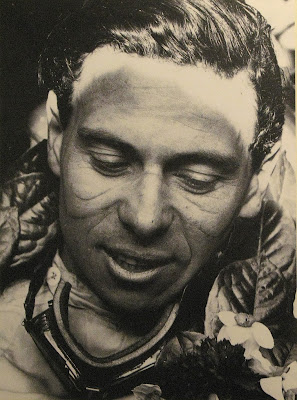
THE STRAIN OF IT ALL

Denis Jenkinson, the best Motor Racing journalist ever, had his own typical forthright view. “Forget the World Championship, just give it to the man who wins at Spa”.

There is an argument that the whole Formula 1 game was not as competitive as it is today, and it's probably true. The rules governing the car's design allowed the shaft of engineering genius to shine through far more than today. But, at the top, the competitiveness was there, be in no doubt. It's just that there were probably 20 people in a racing team rather than the 200+ today. Today it's Toyota, Renault, Mercedes, BMW, Honda, Fiat – then all the teams survived on their racing wits, with no "Big Manufacturer" standing behind them as a safety net.

An elder statesman of the Motor Racing Journalist group has just thrown his hat in the ring and put the cat among the pigeons by writing a book called "Alan Henry's Top 100 Formula 1 Drivers". He has been present at around 600 of the 700 Grand Prix races ever held, and his rankings make excellent reading.

He places young M Schumacher at Number 11.

I can't recall a book on the subject which has got the Motor Racing Blogging fraternity jibbering and foaming at the mouth so much as this list, which after all is just an experienced journalist's view, after a lifetime of watching races. He's not right, just sharing his thoughts with us all.

To him, it is not just points scored which secure your place. Otherwise it would be M Schumacher way ahead of everyone else. His view is much wider – the individual, how he acts, how he drives, the cars he drives, and a much more subtle range of almost emotional issues come into play.

He placed Jim Clark as No. 2 on his all-time list, with Stirling Moss at No.1. I imagine Moss got the nod because Henry thought Clark more often had the best car in the field, whereas Moss indubitably did not. I don’t agree with his order, but so what?

Just to get the statistics on the table, once he had won his first Grand Prix, Clark took part in 56 more Grand Prix races. Reliability then was much more of a lottery than now, and of those 56, he retired from 19, leaving 37 races which he finished. Of those 37, he won 25. That’s 2 out of every 3. He came 2nd only once. For a lot of the time, his team-mate was not a Schumacher style “Rear Gunner” – it was Graham Hill, himself a World Champion. I can’t actually be bothered to check out the whole of Grand Prix History, because I can’t think of anyone with a record remotely like that.

Clark was a strange man. He was born into Scottish Borders farming, and although he undoubtedly changed as his Motor racing life took him over, you felt he never lost sight of this background – as far removed from a Grand Prix driver as you could imagine. He seemed to be an introverted, manically nail chewing, almost reticent individual out of a car. Inside one, he was hard, disciplined, sensitive, the smoothest of the smooth drivers, and supremely fast.

He was a Pole Position specialist, and his racing style was simply to blast away at the start, immediately get a dominant lead, and leave the remainder of the field to fight for Second place.

The sixties were also times when there was no such thing as a Grand Prix Driver. They drove everything. Clark raced large American saloons, Formula 2 cars, Indianapolis Speeedway, Sports Racing cars, Le Mans, “David and Goliath” Lotus Cortinas (see below for a picture which shows what that involved!), as well as taking part in the 1966 RAC Rally.

NOW THIS IS RACING! - CLARK IN A LOTUS-CORTINA


It was this dichotomy between the type of man he was off the race track, and the man whose driving defined the racing era he lived it which has been the source of so much fascination. Most of his peers put him in a different class from the rest, and they should know.

Chris Amon (No 13 on Alan Henry’s list), summed up what Clark’s loss meant - "If this can happen to Jimmy, what chance do the rest of us have? I think we all felt that. It seemed like we'd lost our leader."


Photographs borrowed from Eric Dymock - Jim Clark Racing Legend

Tags:

,
,
,,

Sunday, September 30, 2007

WHAT'S THE SPANISH FOR "SCHADENFREUDE"? - TODAY'S JAPANESE GRAND PRIX

As a sexagenarian (please, for my sake, look it up if you only think you know what the word means), my regular reader could be forgiven for suspecting that I believe everything ten years old is better than its equivalent today. And that everything twenty years old is even better than the ten year old version. And that the fifty year old version – well that’s perfection on a stick.

Not so.

I rabbit on, in these pages, about this and that, and quite often “this” is about Motor Racing, one of my lifelong passions. Usually, I look back through the selective lenses of hindsight, and pick out the good bits, leaving my convenient filter of Early Onset Whatever-its-called to forget the less than good bits. Like the fact that people died doing it with terrifying regularity. In 1968, one top class driver was killed on the 7th day of four successive months. Another blogster worked out that, in the 60s, if you raced for five years, you had a two out of three chance of dying at the wheel. Thank God modern technology has made dramatic improvements there.

I watched the Japanese Grand Prix today, and marvelled at it all. A race which we’ll look back on for a long time, I suspect. It absolutely poured down for the whole race, and if you ever want a scenario which sorts the men from the boys, that was today. The great effect rain brings to such an occasion is that it removes the boring Computer game environment in which most Grand Prix racing today takes place, and it puts the control very firmly back in the hands of those men who know how to drive. And that’s not always those who are paid the most or who have been in the game longest.

You could moan about Michael Schumacher for an awful lot, but when he got in a racing car on a wet track, he was simply in a different league from the rest. Look up Senna’s record in the wet if you ever start to doubt how good he was. Read how Jackie Stewart won the 1968 German Grand Prix by over 4 minutes (yes, Minutes!) in the wet. The cream very definitely comes to the top in Motor Racing when it rains.

Today Lewis Hamilton won almost faultlessly, and if you had any doubts about how good he is (and I admit I did), today sorted them out. But look at who else put in brilliant performances today – Raikkenen, Alonso, Button, Coulthard and Webber all showed their class, and newer boys Vettel (at least until he drove into his team-mate Webber when they were 2nd and 3rd, putting them both out of the race – not terribly advisable!) and Kovalainen, who showed his Renault team-mate Fisichella how to do it all.

And if you see a re-run of the last few corners with Massa and Kubica fighting like spitting cats for (I think) 6th place, you can start to believe that the spirit of Arnoux and Villeneuve at Dijon in 1979 is still alive.

If you don’t recall that race, take a look at this clip.

ARNOUX (YELLOW RENAULT) & VILLENEUVE (RED FERARRI) AT DIJON IN 1979

Anyway, my faith in top class Motor Racing took a leap upwards today. And it’s suddenly quite clear and logical as I write, following my evening meal with a couple of not ungenerous glasses of decent Riesling, how Formula 1 racing should be organised in the future.

Get away from races being won by superior Pit-Stop strategising, and putting one lap more fuel in your car than the other bloke. Stop the grip of aerodynamics overwhelming the whole issue of car design, and putting the mockers on the idea of an overtaking manouevre.

Get all the circuit owners to put a large hosepipe around the track, turn it on at the start of Practice on a Friday and run every race with the track streaming with water, as it was today. The spectators can be comfortable watching it all in the dry, and the drivers can show us all just how good they all really are.

Simple really.

Tags:


,
,
,
,

Monday, August 06, 2007

THE ART OF NOISE

I’ve watched Grand Prix racing now for the best part of 50 years, although today it’s mainly in front of the TV set. There is no doubt that the television coverage does allow you, as in most sports, to get a much better overall picture of what is going on.

But, and it’s a hugely important “but”, you lose out on the atmosphere – Big Time. The buzz and feel of the place, the anticipation, the smell (the reek of the oils? – why doesn’t some brave cosmetics company produce a “Castrol R” Shower Gel?), the real feeling of the utterly absurd speeds these things move at – all get lost on the small screen. But the thing that you lose most is THE NOISE.

The noise these things emit is something else, and either you like it, or you don’t. At its best, it is an intoxicant, and you often see addicts standing far too close to these cars warming up, with no ear protection, absorbing noise pressures which the Health and Safety mob would have a blue fit about, if they were there. Over the last few decades, there have been some truly glorious sounds which you could hear in Grand prix paddocks, but anyone asking “What’s the Best ever?” gets, from me, an immediate unequivocal answer.

The original BRM V-16.

We’re back now in austerity Britain. The year is 1945, and to give some colour to what is a grey, drab country, a man named Raymond Mays started an appeal, almost on the lines of a nationwide Co-operative to build a National Grand Prix Car. The engine was designed by Peter Berthon, and took the form of a 1½ litre V16, the cylinders of which were no bigger than a small Whisky glass. Now you may think 1½ litres is no big deal, but the plans were for this engine to deliver in excess of 500bhp at 12,000 rpm. Remember this is 60 years ago, and it ran on tyres the same size as my VW Golf today!

Four long years later, it took to the road, a fearfully complex machine, the like of which had never been seen before. In the end, it’s fair to say that its staggering complexity was its undoing. It suffered from continual material and design failures, as its highly stressed parts failed to stand up to the tasks they were being asked to perform.

It took to the racetracks in 1950, and pretty continuously failed to put itself on the racetrack where its specification said it ought to be. And then, in 1952, the future regulations for the World Championship were changed, leaving the car with only non F1 races to run in. It was gradually developed, and had a good deal of success in the lower formulas, but, as the Great Hope of so many British people, it was a continual disappointment, winning only 1 World Championship point during its whole existence.

All of which is of nought when you actually see the thing, admire its construction, and then listen to it when it runs. It produces quite simply the most incredible noise anyone with a mechanical soul in them could possibly imagine. A deep, pulsating bass throb which is physical in its intensity, joined to a supercharger wail as the revs increase which is visceral in its power. I like Pink Floyd, I like Wagner (try the closing pages of Götterdämmerung for his cataclysmic view of the End of the World) but I also like, just as much, listening to the sound of this racing car tearing round a track.

Nick Mason, Pink Floyd’s drummer, owned one (a Mark 2) for a time, and wrote a book “Into the Red” which described all the (stupendous) cars he owned. The really great thing about this book is to be found in the Inside Cover. There is a CD where the sounds of these cars have been recorded in high quality stereo sound. To get a feeling of what this piece is about, do the following.

- Buy or borrow a copy of the Book. Get hold of the CD
- Find someone with the largest and loudest Loudspeakers you can
- Get rid of wives and other cissies, pets, and children for the duration
- Turn on the amplifier, and push the Volume Control round to 11 on the Spinal Tap scale
- Insert the CD into the player, and select Track 5, entitled “BRM V16 Mk2 – Push Start and two laps of Donington Circuit – In car".
- Note, the Book advises a “Suggested Volume Setting = Loud”
- Sit back, and

- ENJOY

At the end, I guarantee you will have a huge grin on your face, and be laughing hysterically. Your neighbours from quite a way down the road will be outside wondering just what exactly is going on, and you can invite them all in to hear it again.

I heard it through a pair of large Mission 782 loudspeakers, with a big Sub Woofer to fill in the Bass. Now the specifications for these speakers claim a maximum sound level of 111 db before something untoward happens to the unit’s innards. Suffice it to say, that the first time I played it through, I blew the fuses on both speakers.

The word “awesome” is a bit overused these days. It is not “awesome”, as the Check-out operator in Sainsburys suggested a couple of days ago, that I can add up the prices of my shopping at the same speed as she keys them into her machine – that’s just showing off. But the sound of this machine in full cry does merit the use of the word.

As a pale taster of BRM-lite, try the snippet below from “Youtube”, but remember, if you’ve only got those diddy little speakers attached to your computer, it will be like watching the first 20 minutes of “Saving Private Ryan” on a mobile phone.


ONE MINUTE OF THE V16 BRM MAKING ITS PRESCENCE FELT!

Go for it Big Time, and then tell me you aren’t impressed.

Tags:

,
,
,,
,
,

Tuesday, July 31, 2007

WHY DO ALL FORMULA 1 CARS LOOK THE SAME?

Formula 1 Motor racing has not been a real sport for a long time, it is Big Business.

We’ve seen this in spades over the last couple of days with the spying altercation between Ferrari and Mercedes. Ferrari, the most successful Formula 1 manufacturer over the last few years, apparently discovered that one of their staff had passed detailed information about their 2007 car, together with their operating strategies and plans, to the Chief Designer of another major team, McLaren Mercedes. The decision of the World Motor Sport Council, (the sports’s Governing body) to “impose no penalty” on McLaren Mercedes, in spite of the fact that they found them “in breach of Article 151c of the International Sporting Code” has put the cat well and truly among the pigeons. This Article covers the area of "Any fraudulent conduct or any act prejudicial to the interests of any competition or to the interests of motor sport generally."

This story became public in late June, but there seems some doubt as to when it all started. It could well have been as early as March this year that secret Ferrari documents had been passed to McLaren’s chief Designer. It apparently only came to light when someone in a Photocopying shop became suspicious when a customer came in to copy some 780 pages of documents with Ferrari’s logos on it, and presumably “Secret” or Highly Confidential” blazened all over the documents.

The photocopying shop contacted Ferrari, and the rest is typical Formula 1 viperish history. Ferrari subsequently sacked Nigel Stepney, one of their engineers and took him to court, and McLaren Mercedes suspended their Chief Designer Mike Coughlan.

You can't help feeing that this is pretty important stuff. Bond style espionage (actually Bond would not have gone to a Woking Photocopier shop to get the papers copied!), mixed up with the two teams at the top of this year's World Championship. A Ruling Body that wants this year's tight challenge to continue down to the wire, and needs a legal battle to drown it all out about as much as it needs a hole in the head, and you have the stuff to write a decent thriller.

The sport’s governing body met on Thursday to consider the issue and made an interesting, and I think very sensible decision. It does however, leave several areas where you sit scratching your head, and asking all sorts of questions.

1 – What happened during the 9+ weeks (and Ferrari say it’s a lot more than 9+) that the 780 pages of information were in the possession of McLaren’s Chief Designer. Did he, clandestinely or otherwise, use the knowledge in the documents to further the cause of McLaren’s racing programme? And anyway, once you know something, how can you ever unlearn that knowledge in the future? Some argue this view is like saying It's alright to come into possession of some else's jewelery, as long as you don't wear it.

Some say there were others in McLaren who, at least, were aware that he was in possession of the documents, although they were not made privy to the contents. Others again say not.

2 – How did Ron Dennis, McLaren’s boss, on the day after he learnt of the issue, become totally convinced in such a short space of time, that none of the 750 or so McLaren employees had been exposed to the actual documents or the knowledge contained within them? Even accepting the speed that Motor racing moves as a business, that’s moving very, very quickly indeed. It does make you wonder just how comprehensive a review anyone could have carried out in that space of time.

3 – Honda’s Chief Executive, Nick Fry, reports immediately after (interestingly, not before) the disclosure of the document transfer that McLaren’s Chief Designer and Ferrari’s Nigel Stepney (the man charged by Ferrari with having passed the documents onto people outside the company) had met him in June to discuss the possibility of “investigating job opportunities within the Honda Racing F1 Team.” Honda’s statement records that Nick Fry informed Ferrari of this meeting but, interestingly again, does not specify when they advised them.

It is only circumstantial, but Honda’s performance this year in Formula 1 (and last year's if you look) can only be described as dire, and to date this year they have shown no signs of making any real improvement using the current design team. So, it would be understandable, some people are arguing, if those in charge were looking for some sweeping changes in the future. Rumours abound that the real purpose of the document transfer, could have been in this sort of direction, rather than McLaren. Will we ever know?

4 – The WMSC is, after all, the body tasked to look after the affairs of World Motor Sport, and is not an “independent” legal body like the House of Lords. Ferrari were not allowed to take any major part in the WMSC proceedings, although McLaren were given centre stage there. The decision to find McLaren guilty of breaking the all-important Rule 151c, but to avoid an immediate penalty, is not therefore particularly surprising. Apparently, with Ferrari not having a vote, the decision was unanimous. But don't forget, they are not a Court of Law - it seems to be more like "Physician, Heal Thyself."

5 - Perhaps this explains why Ferrari are conducting a parallel claim through the (possibly) more independent Italian Courts to prosecute Nigel Stepney, their ex-Chief Mechanic. They already have experience here, where a discovery in 2003 that that year’s Toyota Formula 1 Car bore a remarkable similarity to the previous year’s Ferrari, led to two of Ferrari’s employees being found guilty, in April this year, by the Italian courts (four years later, you will note), of industrial espionage. They were each sentenced to 16 and 9 months in prison.

6 - Toyota, like Honda, has invested hundreds of millions of pounds in Formula 1, and is a company with very high expectations of success. These hopes have, to date, have almost totally failed. Several other Toyota employees are still waiting to see if the German authorities, who were apparently awaiting the results of the Italian Court cases before proceeding, press further charges against them. Watch this space.

7 - Although Ferrari are “big boys” here, one can understand their position, feeling that it seems always to be them who are the victim. I suppose, if you build the best car, and have the best team organisation, which is the undoubted situation over the last 10 years or so, then it’s not surprising that you are the team which always seems to be on the receiving end. You just have to ask yourself if someone touting similar information on the Spyker team to Ferrari would draw much interest.

8 - But then, if you go back 10 years, when Ferrari were a bit of a joke in the F1 game, and look what happened, you see how they brought in people like Ross Brawn (from Benetton), Michael Schumacher (from Benetton), Jean Todt (from Peugeot), Rory Byrne (Benetton Chief designer), and over a 4 year period turned the Italian company into the supreme winning machine it has become since 2000. There is an argument here, not for overt (or covert) industrial espionage, but recognising that in terms of transfer of information and knowledge, “What goes around, comes around”. This whole business seems to be all about where you draw the line.

The neat sting in the tail of the WMSC decision, is the sentence in the decision - “But if it is found in the future that the Ferrari information has been used to the detriment of the championship, we reserve the right to invite (what a nice word!) Vodafone McLaren Mercedes back in front of the WMSC where it will face the possibility of exclusion from not only the 2007 championship but also the 2008 championship.”

I have simply no idea how you police that, but it will give quite a few lawyers a means to keep a lot of bread on their table at home, over the next few months. Let’s hope that the championship is decided on the racetrack, rather than relying on the courts trying to decide the legalities of all the new developments on the McLaren Mercedes after the last race of the season, and even into next year.

Anyway, at least this spat is a good deal more interesting than many of the races we’ve seen this year. Be thankful for small mercies.

Tags:

,
,
,,
,
,

Saturday, June 23, 2007

YOU CAN'T PLEASE ALL OF THE PEOPLE ....

Anyone with the slightest interest in Motor racing today, cannot but have noticed the meteoric rise to almost super-stardom, in only a few weeks, of Lewis Hamilton. Having been nurtured and mentored by Ron Dennis, the boss of McClaren, he slid smoothly into the absolute top echelon of the sport, having very precociously won Two Grand Prixs after starting in Formula 1 only in March this year. It took everyone else ages longer to get to the same position - Schumacher, for instance, took over two years, not two months, to get two wins under his belt.

And, apart from being a very fast racing driver, the guy seems to be disarmingly and unfailingly nice, he's totally fluent in "corporate speak" as if he's known the language for years, he's utterly polite, and seems to be the perfectly equipped individual for a sport which is heading into new countries, and even continents, at a rapid rate. Everyone seems to have a view that he has no faults - in a sport where image is so important, he is a Marketing Man's dream.

Except - he's not the only British Formula One driver on the scene, and a simple image taken at the marvellous Festival of Speed at Goodwood yesterday may well have identified at least one person who probably wishes he'd never heard Lewis Hamilton's name.

Seen on a very large pile of identical scale model Racing Cars for sale on a stall.


Tags:
,
,
,,

Monday, April 16, 2007

FORD F3L - MY CAR

I penned a piece a few days ago about Jim Hall, the driving force behind the amazing Chaparral Sports racing cars in the late 60s, and it got me thinking again about the idea of the “Art of the Racing Car”. I am not really sure where the idea of “Beauty” stands in relation to such a violent piece of machinery. You could take a view that “Beauty is in the eye of the beholder”, or you could take a view that Function is the sole requirement of a car which simply tries to go round a circuit quicker than any other. The idea that if it does what it’s supposed to do better than any of the others, that makes it beautiful.

Personally, if you ask me to choose between the two, the answer is “Yes”. Both.

The designer can draw a car which satisfies my idea of aesthetic beauty. Look at the Gurney-Weslake Eagle and you will get a flavour of what I mean – its nose mimicking an eagle’s beak, the quite exquisite detailing on the chassis. If you ever get a chance to see one in the flesh, just look, for instance, at the fuel filler cap - it could win a design prize on its own.

But you can also build a car, which, simply because of its outrageous performance, is beautiful in another way. Look back at the Chaparral 2K Model which Jim Hall produced in 1970. It actually looked as if the front half of the car, and the back half, had been designed by two different teams of engineers who didn’t meet very often. But, judging it on the Function argument, it was a real beauty.

This piece is about a car which I think takes a lot of beating in the real “Whow, just look at that” Beauty category – the Ford F3L 3 litre sports racer (or P68 to give it its official designation).

It was produced very quickly following the end of the old Sportscar formula in 1967. Ford had just produced one of the greatest racing creations ever with the launch of the DFV V8 engine, and this was mopping up Formula 1 in an utterly dominating way. As a result, some bright spark had the brainwave that here was JUST the engine to power a Prototype sports-car for the new formula, which could blow all the other new cars into the middle distance.

Alan Mann Racing, with “a little help from their friends” designed and built the P68 machine which emerged just in time for two of them to enter the BOAC 500 Mile Endurance race at Brands Hatch in April 1968.

Now here I must “declare an interest”. At this time, I was studying Aeronautical Engineering at Imperial College in London, and in the final year, every student undertook a large “rites of passage” type of project or dissertation. Given my fascination with Things Vehicular, I chose to investigate “Motor Vehicle Aerodynamics”. As part of my practical work, by means still not clear to me, I obtained a 1/6 scale model of a new sports racing car then under development, and was given this to test in one of the colleges many Wind Tunnels.

I’m sure you will see where this is all leading. The model I was testing turned out to be the P68, and I spent many happy hours looking at its drag and lift characteristics. As you can imagine, it became “my” car – I had played a small part in its development, and for a 20 year old, that really meant something.

PICTURES TAKEN IN 1967 IN IMPERIAL COLLEGE WIND TUNNEL OF MODEL ON TEST


When it was finally announced in the Press, the finished article simply took my breath away. Its feline, almost feminine grace was something I had never seen before in a racing car. To me, it was the most beautiful racing machine I’d ever seen, although perhaps, I was a tad biased!

And when it was clear that it was finally going to race, I shot down to Brands Hatch, to will it on. The rest of the story that day was a simple, unmitigated disaster. The plan apparently had been for one of the pairs of drivers to be Graham Hill and Jim Clark, but contractual commitments and obligations had intervened, and they went off to Hockenheim to race there. They were replaced by Bruce McLaren and Mike Spence. In the event, one of the two cars didn’t start, but the McLaren/Spence car was second on the grid.

As happened so often in those days, the cars had hardly turned a wheel, before being committed to the track. Sometimes it works – just read the debut of the Lotus 49 at Zandvoort the previous year – but most of the time, it doesn’t. And it didn’t at Brands Hatch that day. After, I think, a bit less than an hour, it stopped with a broken drive coupling. Bummer.

THE REAL THING - TAKEN AT BRANDS HATCH ON APRIL 7 1968

It was only after the event that the real catastrophe of the day became clear. Driving up the hill out of the circuit, I turned on the 6 o’clock news to hear the newsreader report that Jim Clark had been killed that afternoon at Hockenheim.

To me, Jim Clark was, and still is, the best driver I have ever seen in a car. His ultra smooth, calm, undemonstrative style of driving was so at odds with the speed he could produce. He was literally in a class of his own, and so much better than anyone else around him. And to hear that he had been killed in an inconsequential little race in the middle of Germany, when he should have been here at Brands Hatch, driving “my” car, and still been alive, was too much to bear. I remember pulling off the road, and sobbing my heart out.

After that day, Formula One ceased to be a passion. The price you sometimes paid was simply too high.

Tags:


,
,,
,
,,
,
,