Wednesday, October 25, 2006

SCHOOL MEMORIES - DAILY TELEGRAPH STYLE

THE HITLER OAK BEING PLANTED AT BEDFORD - 1936

It’s amazing how a simple thing like a letter in a newspaper suddenly floods your memory with thoughts of the past that have lain dormant for decades. I am indebted (as they say on “The News Quiz”) to Malcolm, my brother-in-law, bon viveur, great chef, and generally Good Egg, for a snippet from the “Daily Telegraph” of a couple of weeks ago.

Although we had never met until I set about marrying his sister, he and I both unknowingly went to the same school – Bedford. As it happened, his other Brother-in-Law, and his wife’s other brother also went there, so there must be something in the water of the River Ouse which flows through the centre of the town.

Anyway, the newspaper story refers to Jack Beresford, an oarsman from Bedford School, whose name has faded into most people’s distant memory. However, in his day (the 1920s and 30s), he won 5 Gold and Silver medal in consecutive Olympic Games from 1920 to 1936, a feat only surpassed recently by Steve Redgrave. Leni Riefenstahl filmed him as part of her stunning “Olympia” project in the 1936 Berlin Olympics. That's quite a record.

The story in the letter recalls how Beresford not only carried the British flag at that utterly unforgettable event, but as one story goes, he so impressed Hitler by his prowess, that Hitler presented him with an Oak Sapling. This was brought back and planted in the grounds of the school (see Picture above), to be known thereafter as the Hitler Oak.

As the march of time, and more physically the march of New School Buildings, progressed, the the Oak was removed and the Biology Department took cuttings from it and these were planted throughout the school estate. Also, wood from the oak was kept back and used as bowshields for the successive generations of Bedford School Boat Club Oarsmen, with a formal signed authentication being added to each one by the Master of the Day to confirm their origin.
History is made of little vignettees like this. Probably meaningless to most people, but quite touching to an Old Bedfordian.

It does make you ponder about the Alumni of the School. I’m not a great “looker-back”, and school holds mixed emotions for me – it was a very sports biased place, and my abilities in that direction were, in the words of a famous Cricket person, “never going to trouble the Scorers”.

But a swift trawl over the Internet makes you realise how many individuals from the School went through the same training course as myself, and went on to achieve true greatness in multifarious spheres. The list I came up with, in about 10 minutes, is as follows. I’ve excluded a whole raft of hugely worthy individuals who, if you put them all together, seemed to run the Armed forces of this country for many decades. It must have been the CCF Army Training!
This lot makes me feel quite in adequate, but in a strange way, it all gives you a rosy glow to think that the teaching skills and training we received at school could have produced such a range of talent – and all because of a letter in the “Telegraph”!
Who wants mediocrity - Not me!
Bob Clay (in my class!) – Ex-Trotskyite Labour MP. He also masterminded the Parliamentary campaign of Reg Keys, who stood so memorably against Tony Blair in the 2005 General Election - do you recall Blair's face when Reg Keys gave his election address at Sedgefield after getting 10% of the votes there - the image of the campaign, in my view.

Harold Abrahams – immortalised in David Puttnam’s film “Chariots of Fire” as the winner of the sprint in the 1924 Olympics


Jack Beresford – Oarsman who won 3 Gold and 2 Silver Olympic Medals - 1920-1936


John Fowles – Author of “The French Lieutenant’s Woman” and many other literary marvels
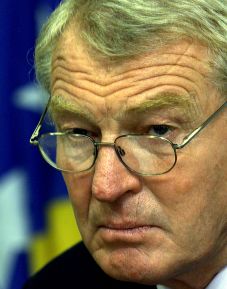


Paddy Ashdown – Ex Leader of the Lib Dems, writer of terrific Diaries, and Saviour of the Balkans
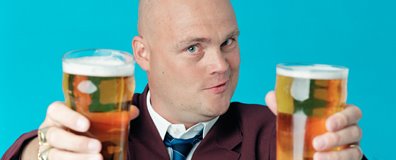


Al Murray – Comedian

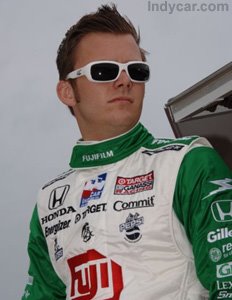
Dan Wheldon – Britain’s most successful Racing Driver over the last few years, but you haven’t heard of him because all his success is in the USA. Won the Indianapolis 500, and the last Brits with their name on that trophy were Jim Clark and Graham Hill – you wouldn’t mind following on from those two geniuses!
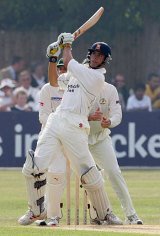
Alistair Cook – Cricketer - Left handed Batsman who played so brilliantly against Pakistan in 2006, before someone “tampered with the ball"
Tags:
,

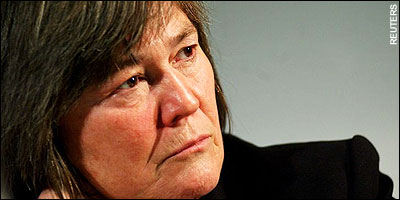
CLARE SHORT


It has seemed like an accident waiting to happen watching for Clare Short to resign the Labour Party Whip. She has held the party whip for nearly 30 years, and has been a Labour MP for 23 years, after working for some time, believe it or not, as Private Secretary to Conservative Minister, Mark Carlisle.
Her robust, outspoken approach was clearly never going to sit comfortably with the “control freak” Apparatchiks in Number 10. Her inability to come to terms with the “New Labour” approach has been manifestly obvious, from the day Blair came to power.

The Labour powers that be tried to reign her in by keeping her “inside the tent” (see Lyndon B Johnson for the origin of that phrase!), sacked her from the Cabinet when that didn’t work, and I suspect then decided that she was simply a loose cannon in New Labour, and, on the outside, tried to ignore her and hope that she would go away, whilst, inside attempting continuously to neutralise her from any effect she might have on the outside world. Last week, though, she had clearly come to the end of her tether, and wrote a delightfully bitchy letter of resignation to Jacqui Smith, the Labour Chief Whip.

Dear Jacqui,

I am sorry it has come to this, but after a lifetime of service to the Labour Party and 23 years in the House of Commons I think I am entitled to discuss what has gone wrong with the government and our political system in my remaining years as an MP.

It is my view that our political system is in trouble and that the exaggerated majorities in the House of Commons have led to an abject parliament and a concentration of power in Number 10 that has produced arrogant, error prone government. …………………..

………….As you know I am critical of many other aspects of government policy.

The previous chief whip tried to use her authority to stop me discussing the fact that the prime minister engaged in a series of half-truths and deceits to get us to war in Iraq. You focus on my views on electoral reform.
The consequence is a string of rebukes, usually through the media. .............

Now come on Clare, tell us what you really mean. It’s nice for once, isn't it, to see a modicum of bile and “Sod You then” in such a letter? For goodness sake, if you don’t feel like that about it, why are you resigning?

She is one of the few Cabinet level politicians I have actually met, and I have to say, after a couple of hours having lunch with her, I came to the conclusion that she was a robustly opinionated and rather arrogant individual who seemed was not prepared even to listen to what I and several other local West Midlands industrialists had to say. Needless to say therefore, I do not wholeheartedly agree with her overall political slant. I am however very, very firmly of the opinion that the UK political scene needs more people like her. People who are not afraid to go against their own party line if their personal views do not match those of their leaders. There are so few of those around that we need to slap a Preservation Order on the ones that remain.

I mean, what sort of Parliamentary system are we operating when anyone who dares to voice a personal opi
nion which differs from the Party line, as defined by the Whips Office, is vilified, accused of being a traitor, and generally disowned by her Party colleagues. It does call into question the whole ethos of the way we are governed today. Maybe I’m missing something, but the fundamental responsibility of a politician is to the people within the constituency which elected them. We seem to have slid into an era of total “presidentialism” where the sole aim of most politicians is to support “willy nilly” the dictates of the Party Leaders, and to subjugate their, and the electorate’s views, totally to those of the men at the top of their party. It is,very sadly, the only way today to climb “the greasy pole”. Sometimes you do wonder what it’s actually lubricated with.
In spite of what I thought was my own personal opinion of the good lady, if you stand back and look at the issues which she has personally raised in disagreement with her Party whilst they have been in Government, it makes very interesting reading. Look at the list which was put together in the “Times” the other day.

- Proposed discussion on decriminalisation of Cannabis
- Spoke out in 1997 about her views on the Millennium Dome – “a silly, temporary building”
- Denounced University Top-Up fees as “a really bad idea”
- Criticised Government “control freakery” about target setting.
- Threatening to resign before the Iraq war if the Government took us into the conflict without a clear UN Mandate

The really scary thing about that list is that if you asked the man and woman on top of the Clapham Omnibus (actually you can’t now, because they took them all out of service, but you know what I mean!) I’ll bet that out of the first 100 you asked, 95 would generally say that she was right, and the Government was wrong

And we are left with an administration that was more than happy to get rid of someone who thought much as most of us do. There is no doubt that by not resigning at the time war was declared, she did her personal standing considerable harm, and her “colleagues” have wasted no time at all in attempting to belittle her, her opinions and to some degree her integrity. But one thing you cannot take away from her is that she is prepared to voice her opinions, knowing that they may well not be universally agreed with. There are very few MPs today who have the guts to do that, and if she leaves parliament after this session, it will be another nail in the coffin of MPs being individuals who have their own opinions which they are prepared to voice.
There are now 4 Independent MPs in Parliament, following her decision to sit out the remainder of the Term as an Independent. The others are George Galloway, Dai Davies and Dr Richard Taylor. The three of them apparently are starting what they call a “Naughty Club” and are thinking of inviting Ms Short to join them – they are, as they say, the only party in parliament which is on the up.

The more I see of the mainstream crews in Westminster, the more I think if mavericks like these branded themselves as a “None of the Above” Party, they would get an influx of like minded individuals setting up camp with them.

Now, where does that one lead?

Monday, October 23, 2006

MICHAEL SCHUMACHER

I can’t let yesterday go by without doffing my hat to Michael Schumacher. He raced (and didn’t he race!) into what the record books will meaninglessly note as 4th place in his last Formula 1 race ever. Just looking at the numbers of his career however – Wins, points, pole positions, fastest laps etc – you’ve got to be uniquely impressed.

Everyone who rabbits on about him, including me, seems to sum him up as a “Flawed Genius”. And that’s what he is. One columnist got it dead right recently when he called him a “Villain”. That he was, and his incomparable drive to win, seemingly at any cost, can be seen as either an example of total focus for anyone looking to excel in anything, or a demonstration that if you don’t keep a real sense of proportion in your life, you can be seen as missing something vital in your personal make-up.

You choose.

But concentrate on the Genius bit for a minute. Without probably realising it, whenever an F1 race took place in the world, over the last 10 years, you always looked at what Schumacher was doing, and then compared everyone else against him. If you got anywhere near the man, you were doing alright. If not, well he was Schumacher, so you weren’t supposed to anyway. It’s quite amusing to see all the pundits who went head to head with him – Brundle, Blundell, Irving, Barrichello, rationalising the simple fact that he was capable of driving a racing car faster than them all, in every way other than the truth. Egos must be maintained!

He simply bestrode the World’s richest sport in a unique way for almost a generation.

And, for once in a sportsman, he was bright enough to hang up his boots when everyone was still clambering for more. You don’t need many fingers to tick off a comprehensive list of other sportsmen who have got that one right. Goodness knows what he’s going to do now – I don’t think even he knows yet. He just knows that now is the time. My own suspicions are that his name will not disappear completely from the Motor Racing scene, but I don’t think he will drive competitively again.

The real test of what he did for the sport is to look at what’s left now.

The fastest drivers on the grid today are Raikkonen and Alonso, but neither of them have Schumacher’s wily, political, devious and intellectual mind – the mind that can get a team like Ferrari to build their whole racing approach around one man. Alonso still displays a Spanish, mercurial, easy to dislodge temperament, and Raikkonen comes across as a brattish, monosyllabic (on his more loquacious days!) adolescent. Both of them excellent racers, not just drivers, but no match for Schumacher in the murkier and darker side of the Sport. The rest of the grid, perhaps with the exception of Button (jury still out) and possibly Kubica (too new) and Massa (let’s see him next year), come across simply as journeymen, scrabbling around for the lesser prizes.

It will be a great shame not to see the Red Baron pointing out in his slightly supercilious way how the others are not quite up to the task, ever again. But if you want an example of putting your Marks (or is it Euros now?) where your mouth is, just look at his final fling yesterday.

He clearly set out to finish with a race you were going to remember, win or lose. A puncture early on which dropped him a lap back, and then you saw a display of real driving when he pulled back all the lost time on everyone in the field other than his teammate. Yes, he probably had the fastest car, and yes, a couple of them let him through without much of a fight. But Raikkonen didn’t, and the move Schumacher pulled on him, 4 laps from the end of his racing career told the story completely – brilliant driving, real guts, great skill and and determination, and Never Give Up – what more do you want from someone who races cars for a living?

I will miss him tremendously.
Thanks Michael.

Sunday, October 22, 2006

THE DEVIL'S IN THE DETAIL - CAR CRASHES

When you see something classed as “Five Stars”, what do you think it means? I bet it’s something like “The best you can buy”. That seems to work for Hotels, Sandwiches, Restaurants and the like. But not, it seems, for something as important as Car Safety, where the difference between the various levels of crash resistance can, literally, mean the difference between Life and Death – and Your Life and Death at that.

The Department for Transport has issued a couple of intriguing reports recently, which have set my mind wandering on this subject. Having spent most of my working life in the vehicle industry, I have watched the way politics and car design interact, with more than just a passing interest. One area which has fascinated me for some time has been the way Governments have approached vehicle safety, and in particular the NCAP tests, which now get such prominence in car advertising. Anything less than 5 stars today is seen as a failure whenever a new vehicle is introduced.

The niggle that has always been there in my mind is simple. How can a big car get five stars and a little car, with much less metal in it, and everything in it being much closer to the squashy bits of the occupants inside, also get five stars. The simple answer is that ***** is not an absolute measure of safety – it’s a relative one, dependant upon the size of the car. A rating of ***** in a small car does not give the same level of protection to the occupants as ***** in a larger car – it’s relative to other cars in its class.

Now I’m a simple person, but I’m not sure that this situation is made at all clear to anyone buying a new vehicle, and something inside me says that there could easily here be a policy of confusion produced by someone to keep this issue unclear. Safety in a car is what I would call “binary” – to me, if you have a crash, you are entitled to think that if you buy a car with a ***** ratings, then you are buying the safest car you can possibly buy – unfortunately Not True. The reality is that a larger vehicle, quite possibly with a 4 Star rating, could easily turn out to be much safer in a crash than a smaller vehicle with a 5 Star rating.

If you equate difficulty to find information with the aim of keeping a degree of confusion and uncertainty going, then the government agencies are also a little coy about this. If you read the small print in their documents, you will find a note that is presumably meant to address this issue, but it is writ very small, and is not at all helpful in the explanation it offers. It’s the sort of thing their lawyers would insist on being included, but only after the Marketing Spin Merchants have woven their spells on the language, so it doesn’t actually tell you anything. So when you look to find out how safe in the real world a big car is compared to a little one, you do not find our Lords and Masters being over zealous and overforthcoming with the answers. In fact until now, you had a bit of a task on your hands to get any solid information at all.

But now, the Department for Transport has issued a report which lifts the carpet a bit on this – and it makes for interesting reading. In a report called “Cars: Make and Model: The Risk of Driver Injury in Great Britain: 2000 – 2004”, they have analysed all reported car accidents involving 2 cars between 2000 and 2004, and the report presents their findings.

Rather than go into the 30 pages of information, let’s look at the really important questions. I suspect that everyone who drives on the road would expect to receive some form of injury, slight though it may be, if they were in an accident. Common sense says it goes with the territory. What I suspect is really important to people is the likelihood of receiving a serious injury, or even being killed in a car accident. So let’s concentrate on this area.

If you look beyond the statistical “standardisations” and caveats in the report, the risk of having a Fatal or Serious Injury in a 2 car accident is as follows –

Small/Low Sports cars - 6%
Small cars - 7%
Small/medium cars - 6%
Medium cars - 5%
Large cars - 4%
MPVs - 4%
Four wheel Drives - 3%
All cars - 5%

Now, I guess Common Sense (that particularly rare commodity) would see those figures as reasonable and sensible. Those of us who have studied Physics, and can remember such things as the Law of Conservation of Angular Entropy or whatever it's called (see, it’s all coming back to me now, even after 40 years) will agree that when a big thing hits a small thing travelling in the opposite direction, it’s usually the small thing which comes off worst, and that’s what the data seems to be supporting. But if we look a little closer, there are a few things which seem also to be clear, but which you seem to have to work out for yourself.

In the small car category, the Rover Mini (emphatically not the new one) is the most dangerous car they measured, at 14%, twice the class average, and the Citroen C3, is at 3%, more than 50% better than the class average. That’s less than 25% as potentially dangerous, one car versus the other. Interestingly, in its class, the C3 only gets 4 Stars in the NCAP tests. The Nissan Micra (1993-2003) is rated at 4 stars, and suffers an 8% Killed or Serious Accident rate, whereas the C3, the Mercedes A Class, and the latest Polo’s figures (all also rated at 4 Stars) are all 4% or less – 50% better for the same rating.

As you get up to the larger ranges of cars, the variation between models become much less marked. For instance, in the Medium car category, the Killed or Seriously Injured range is between 3% and 7% (excluding the Subaru Impreza at 8%, and that, I suspect would have something to do with the type of drivers it attracts).

In the Large car class, for vehicle which are available today, the range narrows again to 2% - 4%. Once again, Common Sense coming good.

The one which must get up many people’s nose is the 4 wheel drive category. Here, the average risk is the lowest of all those measured, at 3%, which once again makes logical sense. You only have to imagine a Mercedes ML Class hitting something like a 2004 Clio, and the fact that the Clio comes off 5 times as badly comes as no surprise. Except that they both got 4 Star ratings in the NCAP tests.

The 4WD category includes a range of large and small 4WDs, and if you do a broad split of the list into large 4WDs and small 4WDs, the difference between them becomes even more intriguing. Within the 3% overall average, the smaller 4WDs have a 3.8% risk, whereas the larger ones are less than 1.6% - twice as good as any other section of the vehicle population. Hmmm!


Now, I know only too well that these Government statistics are measuring a lot of things which the NCAP tests are not measuring – the type of driver, the weight of the other vehicle the cars hit, the Primary vehicle safety characteristics (ie the ability of the car NOT to get into an accident in the first place), the inherent randomness of vehicle accidents and so on. But, these figures seem to show the much maligned 4WD vehicle in a different light. Now there are American statistics which show just how important the weight of a vehicle is in a crash, and, once again, it is not surprising that driving around in a large 4WD vehicle, and hitting a smaller car is likely to mean the 4WD occupants are safer – much safer. But no-one in this country seems to make this point as a balance to the “Destruction of the Planet” argument.

It’s a bit like the MMR argument – you may not want to risk your own child by giving them the injections, but you want to be covered by the immunity created by everyone else having theirs inoculated. Your car accident risk will be low as long as most of the other cars on the road are smaller and lighter – so buy the big one and hope that any accident you have is with a smaller vehicle. You can argue it’s not morally right, but how do you convince people not to buy into an unfair advantage, when the benefit their money buys may well be - Staying alive.

To further this point, there is an interesting little statistical Table tucked away at the back of the report, which seems to have escaped comment in the body of the report. Rather than measure risk of Fatal or Serious Injury combined, as all the figures above attempt to do, they pull out the chance of being Killed in each type of vehicle.

The average chance of being Killed in ALL accidents they measured was 0.3%. The figure, if you were in a Small car or Sports car, was 0.5% (70% higher) and for MPVs and 4WDs, the figure was Less than 0.01%.

That’s 30 times less than the average, and 50 times less than a small car.

So now what sort of car do you buy next time?

Wednesday, October 18, 2006

SOUNDS FISHY TO ME


I’m never quite sure about the small “snippets” you get in the News columns in the newspapers. You know the ones, where there is a single column with half a dozen little items which someone deems as not important/good or entertaining enough to merit a part page spread with one or more pictures. Sometimes, I think some subversive sub-editor slides a story in, once in a while, just to see if we are all awake.

One such appeared in "The Times" today. To set the scene, the story of the day, or at least the one which captured the front page headline was “The end of cod” which threatened the cessation of catching the cod in the North Sea, to ensure that the species did not disappear. At first sight, this strikes one as a good idea – now I like (actually, love) Cod as a fish to eat. I won’t go into the “gastoporn” bit about its meaty, white, flaky, shiny and firm texture, but the truth is there are a lot of other fish that are good to eat as well. I am quite happy to transfer my allegiance elsewhere. Look out you Sea Bass, my frying pan awaits.

Actually though, when you delve a bit into the story, there has been a (very low) limit on allowable levels of North Sea Cod catches since 2004 – 26,500 tonnes, to be precise. But, and it’s a bloody big But, the Cod is a big fish, and when the guys who go out fishing do their stuff, and try to catch the Haddock, Whiting, Plaice and Hake which they are allowed to catch, they inadvertently catch huge numbers of Cod. You can see where this is going, can’t you? Now because they would otherwise exceed their Cod quota, they gaily separate out the Cod they shouldn’t have caught, which by the way are now dead, and throw them back into the sea. I haven’t yet written a piece on the Law of Unexpected Consequences, but when I do, this whole sorry saga may appear again there.

It seems to have just dawned on The International Council for the Exploration of the Sea, who seem to be monitoring this, that Cod levels in the North Sea, which should be getting much healthier following 2004’s Draconian fishing restrictions, are actually showing no signs of improvement. Now, maybe it’s me, but that strikes me as heading towards the blindingly obvious. A net which is fine enough to catch a small fish like a Haddock, Whiting, Plaice or Hake, all of which are allowed to be caught, could quite possibly also catch a big fish as well – like a Cod for instance. Quite why this eventuality was not seen as at least possible, escapes me. But then, I live 100 miles from the Coast, so what would I know?

Anyway, apart from the proposal to not catch any fish smaller than a Cod in the North Sea by using coarser nets than today, or somehow ensuring that Cod are genetically changed instantaneously to be of the Dwarf variety, allowing them to swim through the nets currently in use, I have no further useful thoughts to add.

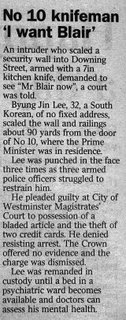
All of which is nothing to do with the intended subject of this ramble. That piece of news was tucked away on Page 4 of today’s Times and is shown in its entirety below.

I cannot make my mind up whether this interesting little vignette is –

- An act of potentially darstadly Terrorism caught in the nick of time by our stalwart Intelligence Services (is that an Oxymoron I see before me?), without whom none of us could begin to sleep soundly in our beds

- Jamie Oliver, skillfully dressed up as a South Korean, to put the aforementioned Intelligence Services off the scent, aiming to raise the profile of his “Don’t let our kids eat Crap” campaign in a very dramatic way. Note, the accused was found with a 7” kitchen knife, something I understand to be available in the new “Jamie Oliver” range in Sainsburys. To off-set this positive but circumstantial point, the accused allegedly demanded to see “Mr Blair now”. Actually, I can’t see Jamie Oliver calling our Tone anything other than Tone, so maybe on balance, this option is the result of an overexuberent intake of Red wine with my meal tonight

- How about one of Gordon Brown’s acolytes, trying a new way of getting Blair out of Number 10? As Morse, or is it Columbo, would have pointed out, he has the motive, he has the weapon, he knows his way around, and it would seem he has the motivation. Interestingly, although the potential assassin was caught red handed, with a knife, asking to get to Our Glorious Leader, having already climbed the wall and railings of No.10, while Blair was in residence, and he pleaded Guilty, the Crown OFFERED NO EVIDENCE, AND THE CASE WAS DISMISSED (My Capitals!). Now what do you make of that?

The other alternative is of course that the man actually was Byung Jin Lee, a South Korean, and he did have designs upon the Prime Minister. In this case the really worrying thing is that he was remanded in custody to allow “doctors to assess his mental health”. Perhaps the sub-editor who looked over this piece before submitting it to the Printing Presses was thinking along the lines of Yossarian out of “Catch 22”, and how the balance between mad and not-mad, sane and insane, rather depends on who you are and where you start from.

And anyway, why wasn’t this front page news?

My confusion is immense.

Monday, October 16, 2006

CRICKETING JUSTICE - 1937 STYLE

I’ve just been looking back at a couple of bits on the blog, namely the two items written when the Darryl Hair vs Pakistan spat was in full flow. You felt then as if you were being chained to a single track railway line, and could see a political and expedient solution heading towards you like an express train. And that’s exactly what we’ve seen.
Inzamam got off as lightly as the administrators could conceivably manage, and Darryl Hair was last seen being driven off at high speed towards the nearest sunset. The friendly fire now seems to have spread and resulted in some Pakistan "collateral damage", namely Zaheer Abbas, the Team Manager, who can now add “Ex-“ to his job title, and also Shaharyar Khan, who seems to have had enough, following Younis Khan refusing to act as captain while Inzamam is on the bench.

Reading between the lines, if that’s possible in the Pakistan Dressing Room, it does seem to confirm that there was a good bit of pushing and shoving in that room to avoid returning onto the field of play during that match, and some people are now paying the price.

Meanwhile, Umpire Hair, who has been castigated unfairly for upholding the rules, seems to have reached the end of the line. It does seem unfair – he’s not there to interpret the rules, he’s there to implement them, and it’s difficult to see where he went wrong.
The solution seems simple to me. The umpire doesn't change the rules - that's anarchy. The Administrators are there to change them, so if the rules are so out of touch, perhaps they should have sacked themselves. Now, I wonder why that didn't happen.

You don’t shoot the pianist - although in this case, that seems exactly what they’ve done.

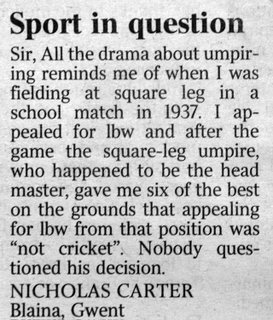
To end on a lighter note, the picky below is a lovely letter from “Outraged of Tunbridge Wells” which shows how it should have been done. Can you imagine the Education Secretary, Alan Johnson supporting such an approach?


The floggings will continue until morale improves!

Sunday, October 15, 2006

SIX OF THE BEST - IRELAND - 1

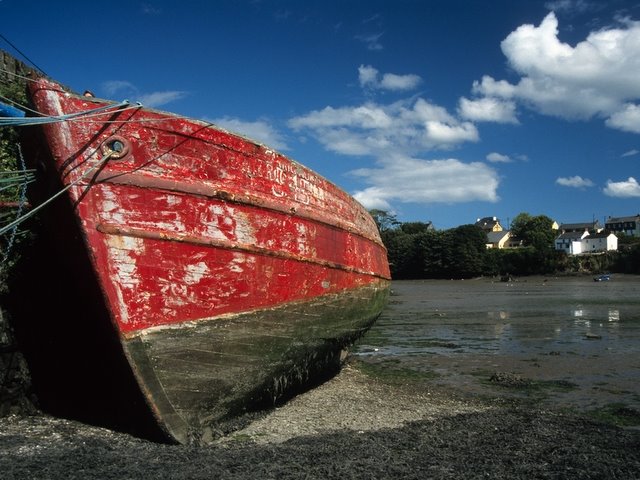
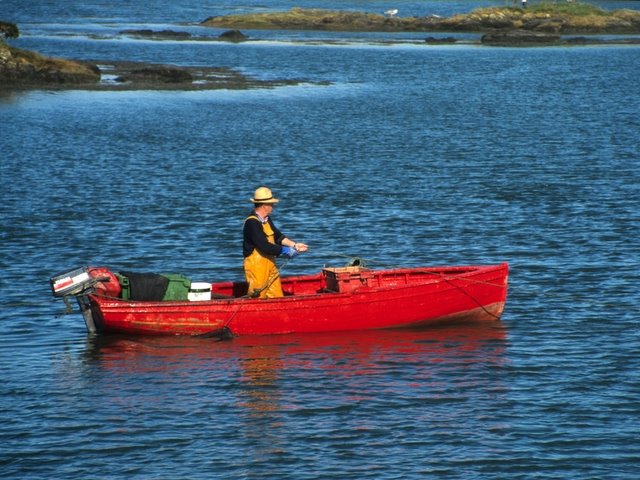
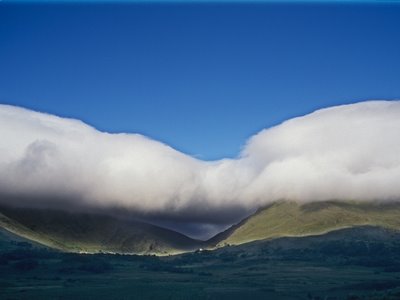
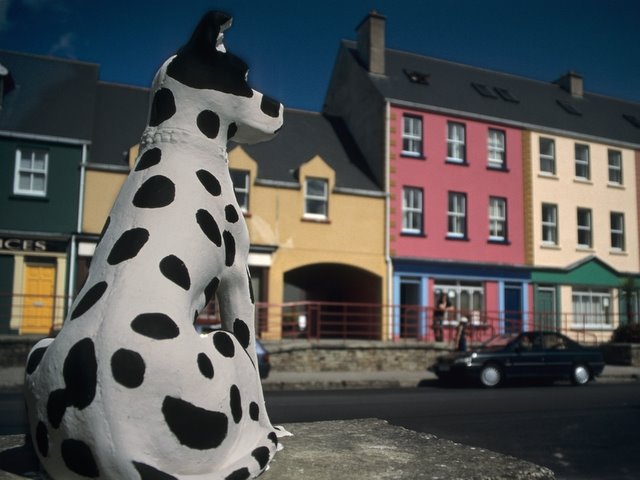
The West Coast of Ireland is a marvellous place. We’ve spent half a dozen holidays there, in Connemara, Galway, Kerry, and on the far South-west tip of the country, in a little town called Baltimore, where the next stop west is America.
ARTIST'S PAINT PALETTE IN KINSALE


THIS IS THE BOAT HE WAS PAINTING

There has been a massive change in the country over the past 10 years or so, mainly fuelled by EU monies (actually, part of that is yours and mine, but that’s another story). Our last visit was in 2003, when we spent two weeks in Clifden, west of Galway, in the middle of nowhere. Not a single drop of rain fell, and with the azure skies and white beaches, you could be mistaken for thinking you’d been transported to the Caribbean. The people were friendly, the scenery was stunning and we did not eat a bad meal anywhere – and the pubs weren’t bad either!


THIS GUY WAS CATCHING OUR EVENING MEAL


GALWAY SHOPFRONTS

CLOUDS OVER CONNEMARA


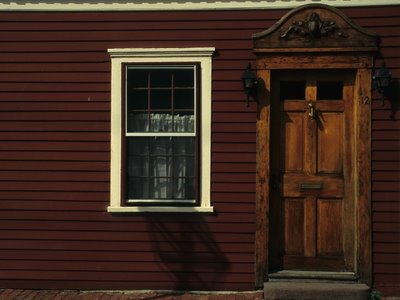
GUARDING A HOUSE ENTRANCE IN CLONAKILTY

I’m sure some of the towns are set out for the tourists, with an utter riot of colours for the house and shop fronts. But it really does come across as a happy part of the world, with a real buzz about it – a positive feel to the way of life and the people. Perhaps they are a bit like the Americans, where the whole of the race seems to be putting on an air of optimism, and underneath it’s not quite as solid. But not many of them drop their guard, and the result is a real desire on the part of the visitor to go back.

In this collection of pictures, I’ve tried to picture the colour and the beauty of the scenery. Many pictures you see of Ireland are grainy, Black and White images, taken in dreadful weather of depressing vistas, needy urchin like children, or battle-scarred suburbs, with a concentration on religious sectarianism. I am not saying that this side of the country does not exist, but my viewpoint is simple – there’s a very different side to be seen if you look.

This is me looking.

Saturday, October 14, 2006

KEN RUSSELL'S "ELGAR"


Back in 1962, a young new director made a programme for the BBC on the life of Edward Elgar. His name was Ken Russell, and he was supported by Huw Wheldon, with whom he co-wrote the commentary, Ken Higgins who photographed it, and Humphrey Barclay, who produced it. And that was about it, the whole thing was made by no more than half a dozen people.


I well remember seeing this programme when it was broadcast, and being totally bowled over by it. Russell went on to bigger things in TV and films, even making several more musical tele-biographies, on such diverse characters as Tchaikovsky, Delius, Bartok and Prokoviev. They may have been bigger, and more extreme, but, to me, “Elgar” was a work of televisual perfection.

Some clever soul on the Sky Channel “Artsworld” scheduled it to be repeated the other night, and it was with some trepidation that I watched it again, 44 years later. I was 16 when I first saw it, and must have watched it then through juvenile, almost childish eyes. It has remained with me in my mind over the years, as a classic piece of Television – one which you felt really was a landmark in the medium. My viewpoint in 2006 would be from a very different point, and my worry was that, on seeing it again through 60 year old eyes, it would be a real disappointment.

I really needn’t have worried. I found it still a quite superb piece of work, and a real marker to the documentary makers of today, who mostly seem to have lost the simplicity, the beauty, the glorious photography, the stunning direction, the perfect pace and the eloquent, understated commentary contained in this little jewel of a programme.

For the first time on television, Russell managed to get the BBC documentary administrators to accept the use of actors in such a programme. We saw Elgar acted out firstly as a young man, changing to a 40 year old man, just married, and finally in his old age as he gradually became almost a recluse in his beloved Worcestershire. Given the subject, the choice of a soundtrack was blindingly obvious, and Elgar’s quintessentially English music, be it the Imperial Marches, the gentle Serenade for Strings, his Second Symphony and the glorious Cello Concerto was allowed to thread its way through the story.

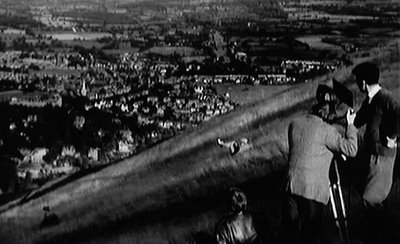
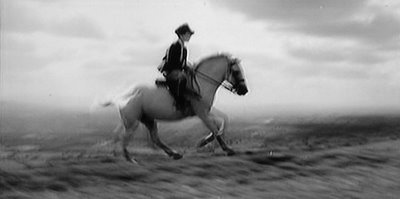
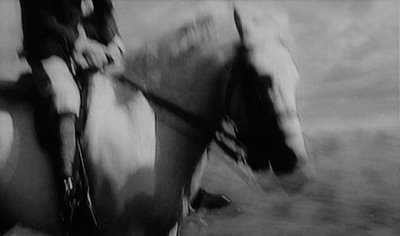
One of Russell’s images, that of young Elgar galloping on a pony along the top of the Malvern Hills to the accompaniment of the Introduction and Allegro, is simply the best fit of music and image I have ever seen. It drilled its way immediately and permanently into my mind. Every time I’ve listened to that piece since seeing this programme, the picture of a boy on a horse flowing across the top of England appears in my mind. Quite magical.


Elgar’s story of accepted greatness only started in Germany, just after the turn of the century, where he became wildly popular, well before England took him to their hearts. Russell picked up the conflict and pain in Elgar’s mind which resulted from England taking up his “Land of Hope and Glory” as a jingoistic military anthem against the Germans, who had given him so much help and approval in the previous 10 years. No wonder he grew to hate the piece.

Huw Wheldon’s commentary is a model of clarity, always informing and supportive, explaining and guiding the viewer’s understanding - but always understated.
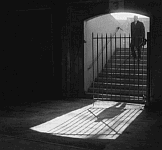
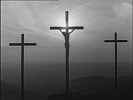
Overall, however, we see a documentary maker of genius at work. Russell is never afraid to use a startling image to make his point. Just look at the sureness of hand and the power in the two images below.


The light and shade in the pictures (it was of course shot in Black and White) show an almost painterly approach to the subject, and Russell is not afraid really to hold an image, and let it breathe for a long time as the point he is making gradually unfolds. As an instance, he uses a simple Poplar wood, shot looking firstly upwards, and very slowly panning downwards to show the back view of a couple, Elgar and his wife Alice, walking into the distance. With no words, just the Cello Concerto playing as a sound track, he paints a picture of the pair of them retreating into the Worcestershire countryside, moving away finally away from the pressures of London life. Very effective.

All in all though, a real eye-opener of a programme. I enjoyed it immensely. If you get a chance to see it, take it. You will not be disappointed.
Tags:
,,

Wednesday, October 11, 2006

DEATH OF A PRESIDENT

They showed a documentary on TV the other night called “Death of the President”, which showed a “fictional” view of George Bush being assassinated in 2007, and a view of the possible consequences. As you can predictably and boringly imagine, there were several pundits who wrote in the next day’s newspapers that such a programme should not have been shown because it would incite some form of copycat action, and that the film therefore put the President’s life at risk.

Ignoring what I suspect is a not inconsiderable number of people who might see that as a plus, do these writers not think that his life is already under threat from an indeterminate range of disaffected groups? Unfortunately these days, it goes with the job. Actually, it’s not only these days. We’ve actually had a bit of a lull recently.

I have to say, a simple look at the statistics would be enough to stop me from campaigning if I was an American. Out of 43 Presidents to date, 4 have been assassinated – Lincoln (1865), Garfield (1881), McGinley (1914) and Kennedy (1962). Actually, if you give half marks for a good try, that becomes 4½ with Reagan. That’s 1 in 10, almost Russian Roulette chances.

So, the idea of planting such an “impossible” idea into the minds of people simply doesn’t stack up. Do you not think that umpteen organisations around the world haven’t already spent a bucketful of their own time and money planning to achieve such an eventuality? Those with a real desire, money and the capability were there ages before the film was made.

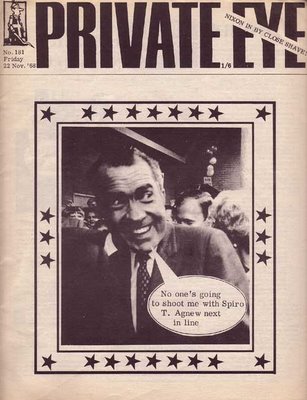
Actually, in a lighter vein, I recall one of the classic “Private Eye” covers, which after a few moments delving into www-land has just come to hand. Actually, I've just realised why the cover was produced. Look at the date on the cover - 22nd November 1968, 5 years to the day after Kennedy was shot.


It shows Richard Nixon, with just the hint of a smile playing on his lips, explaining to the world his strategy for ensuring that he completes his own presidency still alive.

His answer is simple – pick an idiot for Vice President.
Enter Spiro T Agnew.
I have to say, even at the time, when we had got over the initial shock of Kennedy’s death, this cartoon struck a very black, but unfortunately accurate and worryingly to me, a very funny point.

But, one thinks, fast forward to today, and this country. I’m sure I must count myself among millions when I wake up in the middle of the night, palms sweating with one thought on my mind – “Why is John Prescott?”

And here in a blinding flash, is the answer. Blair is not daft. He (or one of his staff) undoubtedly reads “Private Eye”, so sometime in the past, some form of visitation has occurred, and the strategy for Blair’s immortality has crystallised in front of them.

Prescott for Deputy Prime Minister – it’s Oh so simple. The great ideas always are. And keep him there through thick and thin, or until Blair’s reign ends. Brilliant!

But - meanwhile in America. Why hasn’t Bush picked up on this? He’s hardly the nation’s favourite son, and picking Dick Cheney for Vice President is nothing like as effective as Blair’s choice. Perhaps Tone should ring him and have a bit of a “succession planning” discussion. You know the sort of thing –

“Yo Bush, you get rid of that dude Cheney, and pick someone who’d be really good for you. What’s Dan Quayle doing these days?”

You know it makes sense.

Tuesday, October 10, 2006

SIX OF THE BEST - 1960s RACING CARS - 1

One of my adolescent passions was Motor Racing, and thankfully today, there are people of my own age, with infinitely more money than me, and equally, infinitely less sense, who still keep the iconic cars of that era in immaculate condition, and then blast them round a race track as if there is no tomorrow. Their argument, to which I totally subscribe, is that the only point in the existence of these beautiful machines, is to drive them flat out around a track as their designers intended. Usually, it is a glorious sight – occasionally it all ends in a lot of tears, but that's not a bad metaphor for an interesting life!

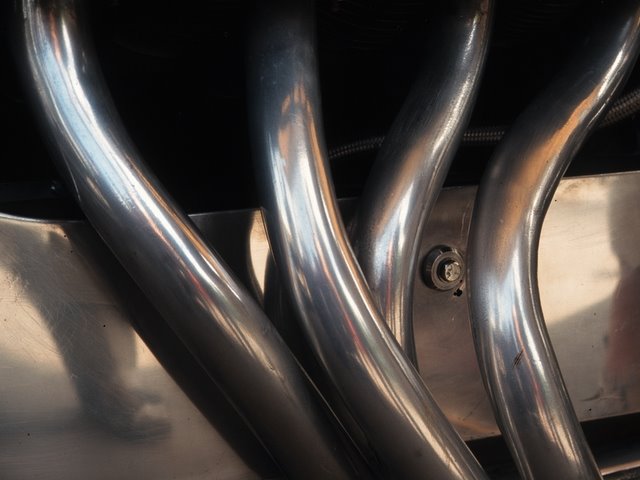
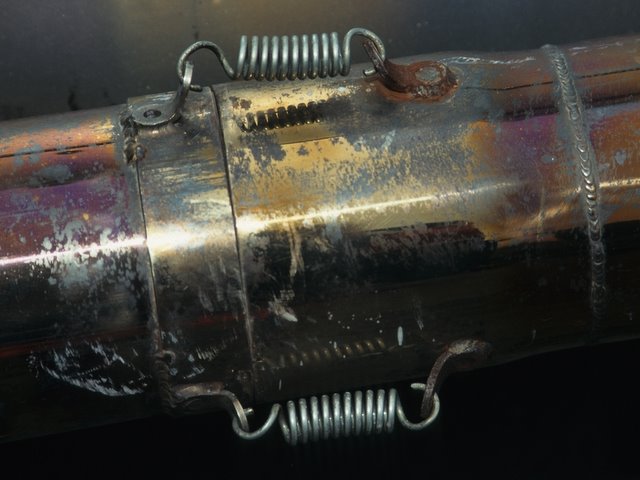
My loyal reader will have noticed already that photographs are a major part of this Blog. So this set of pictures combines the beauty, yes beauty, of the 1960s racing car with a photographer’s eye view of various metal “sculptures” which are part of the visual attraction of these machines. The shapes and form of the various images here are very simple. They reflect visually the Engineer’s desire to design and build something to achieve a simple engineering purpose, with no compromise whatsoever. The result of such a focused, dedicated and pure approach to design, almost always results in something visually very satisfying.

You may, of course think I’ve totally lost the plot by taking a series of pictures of car exhaust pipes and carburettor trumpets. But, to me, they show a simple perfection of purpose which does not occur too often in the engineering world. I have deliberately not done the "anorak" thing and annotated each picture with a detailed description of the car they portray. I'm showing them as mechanical works of art, and their provenance is, to me, unimportant.

And anyway, I like them, and that’s why they’re here!


Monday, October 09, 2006

THE POWER OF A PICTURE

Peter Norman died 5 days ago.

Who, I can hear you saying?

Peter Norman, the Australian 200 metre runner.

Who, I still hear you asking?

He ran the 200 metres in the 1968 Olympic Games in Mexico City and won the Silver Medal. His time was 20.06 seconds, which amazingly, 38 years on, is still the Australian record for the event.

All very interesting, but I still hear you saying – So what? There must be many thousands of similar athletes in the same position.

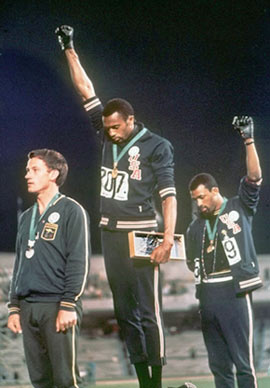
The answer is in the picture below. It remains one of the most vivid Olympic images - a picture which once you’ve seen it, you will never forget. It was a simple, courageous, non-violent protest, a benign but impassioned and hugely effective dissent. They set out to bring further attention and focus to civil rights issues in America, to give pride to African-Americans, and didn’t they just succeed?


Peter Norman, Tommy Smith and John Carlos - 1968 Olympics

The picture shows the Americans Tommy Smith and Jon Carlos, each wearing a single black glove, with their fists clenched and raised in a Black Power salute – a picture which burned its way instantly into people’s consciousness all around the world. Oh, and back to the beginning, that’s Peter Norman standing alongside them, because he came second in the race and split them in the results.

Norman had taken a simple view when he had heard what the Americans were planning to do. In Norman’s words -

Norman said he saw the black gloves. Smith was prepared to don both until Norman said he suggested the pair share them.

"I actually thought John would wear the left one on his right hand," Norman said.

Norman said he asked the two if there was anything he could do to support them.

"I asked John if he had a spare badge for their human rights organization," Norman said. "John said he didn't, but on the way to the victory stand, John called over the fence to one of his friends who had a badge. He took the badge from him and gave it to me."

Norman slapped it on his warm-up jacket over his heart. The trio went to the medal stand. They were given their medallions. The U.S. national anthem began to play.

"There was a guy in the stands who was singing the U.S. anthem so loud it boomed right across the track," Norman said. "We got about four bars in, and he just tailed off."

Smith and Carlos were standing with heads bowed and fists punching the night like thunderbolts.

"Every emotion turned loose on them," Norman said. "There was vocal retaliation."

The Americans were told not long afterward to get out of town, which they did.

It was a strange conjunction of three individuals whose combined visual impact in the photograph was to have a truly remarkable impact on the Black Rights movement over the years. Carlos had previously been with Martin Luther-King 10 days before he was assassinated, so that will have had a massive effect on him, perhaps driving him to think that something needed to be done, and he would never, ever get a better opportunity.

None of the three was particularly close to the other two. After the event, all too predictably, all of them suffered varying degrees of adverse reaction from their sport’s governing bodies and their country’s media.
They all went their own ways over the succeeding years, although the Americans kept in sporadic e-mail contact with Norman. Two rather fascinating threads flow out of it after 35 years. Smith and Carlos were vilified and hounded in the USA when they returned – Carlos found jobs extremely hard to come by and Smith had the pleasure of clearing up his house after bricks were thrown, one suspects not by Black people, through the windows.

But, as so often happens, the perspective on the issue changed completely as time passed. In 2005, a statue commemorating the event was unveiled in San Jose, California, although Norman was not present. But then, in true American style, the statue only showed the two Americans, with Norman, who had added a significant international dimension to the 1968 event, being airbrushed, or is it air-chiselled, out of the piece of art.


Statue of Tommy Smith and John Carlos – San Jose 2005

I am sure that they had no idea at the time just how pivotal their action would turn out to be – it seemed to act as a real focus for the Black movement in the USA, and just seeing the picture today brings the emotions and feel of that moment in 1968 flooding back - apart from Hitler's 1936 Olympics, the first real time world sport was used to further political ends. The trouble from the administrators' viewpoint with this one was it was so, so effective.

The really warming conclusion to the story is that both Smith and Carlos are to fly half way around the world to Australia, and act as pall bearers at Peter Norman’s funeral – they at least know how important his part in this hugely potent little act of non-violent protest really was.

How very, very uplifting.

Wednesday, October 04, 2006

SIX OF THE BEST - LONDON - 1

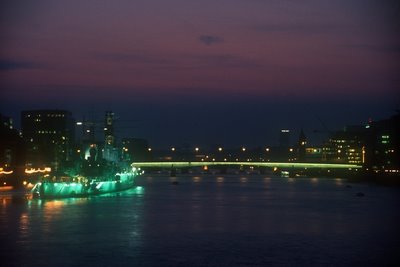
HMS BELFAST
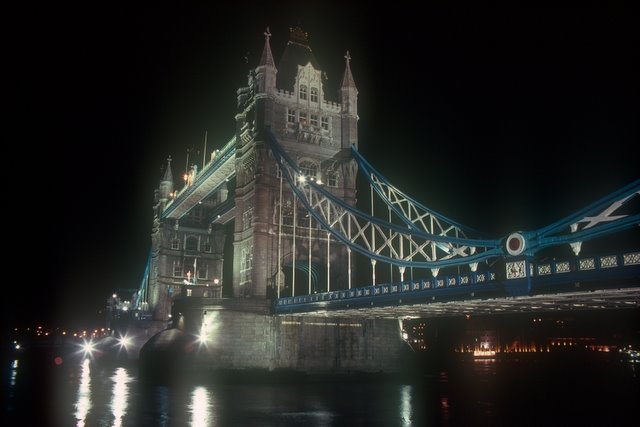
London is an amazing place – its size, its diversity, its life and "buzz" – and its river. There is something about the “super” cities in the world – they all have a river or stretch of waterway which acts as a focus or backdrop. London and the Thames is no exception – the unique shape of Tower Bridge must be one of the most recognised images in the world.

A while ago, we lived in Aylesbury, some 40 miles north of the capital, and in the way these things go, we took little advantage of that nearness until we had decided to move away from the area. That decision to leave spurred me on to realise that if I didn’t get going and photograph my own personal view of London in the next few weeks, it would never, ever happen.

So I set to with a vengeance to put together my own photographic impression of London – not to capture it simply as a record, but to try to get my own feelings about the beauty of the place into my pictures.

Where do you start? The size of the place utterly overwhelms you – it’s 50 miles from one side to the other. And it doesn’t take you long to realise that you can only take one small part - you must concentrate on one aspect, one facet and hope that gives the results you are looking for.

So, almost inevitably, I chose the River.

It was with a degree of trepidation that I started my venture – everyone has their own impression of such an iconic thing as the Thames. You can easily conclude that there are no pictures of the river which haven’t already been taken, so why add your own?

The answer was very simple – because I wanted to.

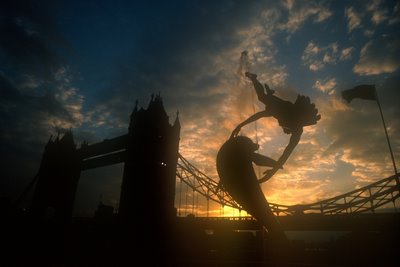
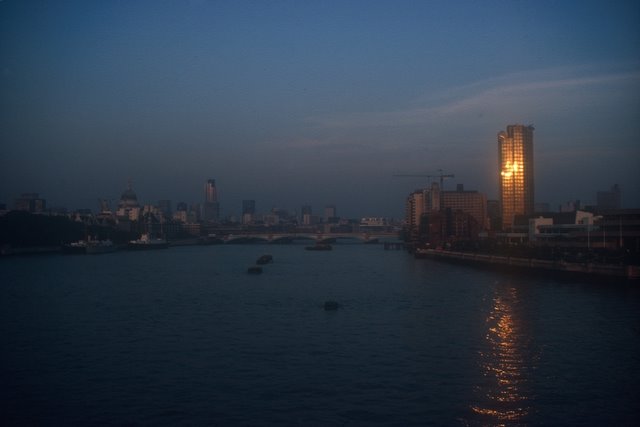
These pictures are the first set of 6 out of around 50 images which make up my own efforts to show why the Thames is so remarkable.

SUNSET LOOKING UP RIVER

TOWER BRIDGE - LATE AFTERNOON

ALL LIT UP


MILLBANK TOWER AT SUNSET


TOWER BRIDGE AT NIGHT

Friday, September 22, 2006

THE CAMERA DOESN'T LIE - EXCEPT WHEN IT DOES!

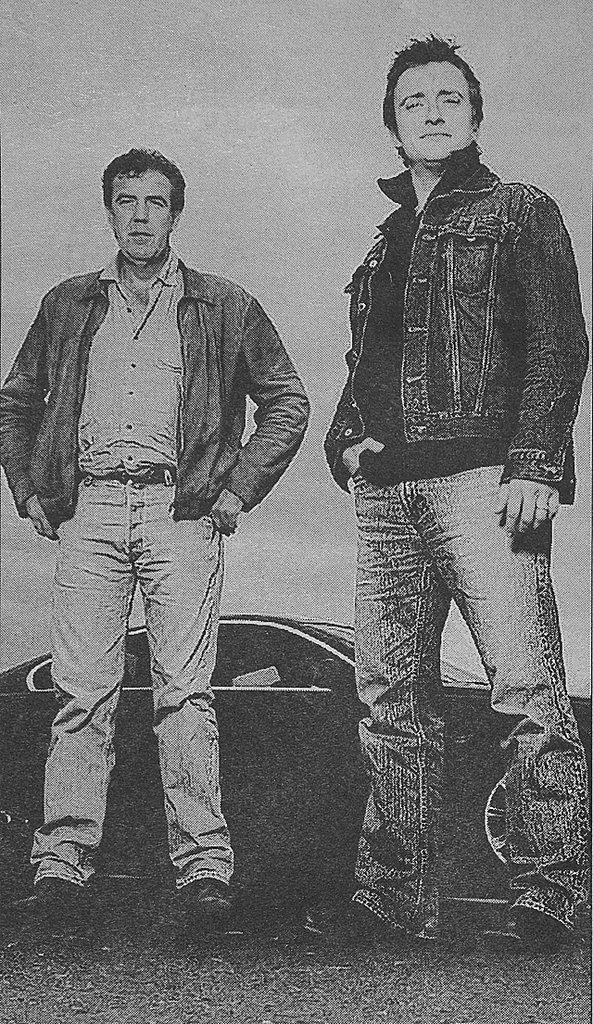
There isn’t that much of a lighter note to the Richard Hammond story (see Blog below), but there’s a picture in the paper today which will please Richard no end when he sets eyes on it.

Aficionados of “Top Gear” will be aware that Hammond is slightly more vertically challenged than Clarkson. Those of you with an analytical bent, where only the absolute figures will do, will be pleased to read that Hammond is 5’7” tall, whereas Clarkson isn’t. He’s 6’4”, some 9” nearer the sun. And, being Clarkson, he doesn’t ever let Hammond get away with his miniatureness.


But just look at the picture – I suspect the Picture Editor couldn’t resist.

Actually, I’ve just used Microsoft’s extremely helpful Spell Checker on this notelet, and it advised me that the word “Blog” doesn’t exist, and that perhaps I would like to change it to “Bog”.

Does it know something I don’t?

CARPE DIEM, MY SON!

It didn’t take long, did it? A few hours after Richard Hammond’s sickening crash at nearly 300mph in a jet car, while filming for “Top Gear”, the Risk Faschisti are circling overhead like grey, miserable vultures.

The guy was driving a car called Vampire, which looks essentially like a B&Q ladder with a huge jet engine strapped onto it. He was blasting down a remote runway in Yorkshire, with only himself for company at the time, trying to break the UK Land Speed Record, which stands at 300.3mph. And it all went wrong, for reasons as yet unknown. So he now lies in Leeds General Infirmary, critically ill with serious brain injuries. My thoughts are with him.

And so the “Greys” emerge. One Superintendent Deacon, from North Yorkshire Police, said, most helpfully that “The organisers of the High Speed Challenge should have carried out a full risk assessment before filming began.” Maybe I’m being too simple here, but do you not think they did just that? Hammond was trying to become the fastest man EVER in this country, and do you not believe that he thought to himself “Jeez, this is Bloody Dangerous.” There is no doubt he would have conducted his own risk assessment before pulling on the 3” wide body harness which strapped him, Oh so tightly, into the projectile. And he would have come to the simple conclusion “Start her up, baby!”

He knew clearly what he was letting himself in for, and couldn’t wait for it to begin. People around him report that he was euphoric just before his last run in the machine. For someone besotted with motor cars, sitting in one which reportedly took 6 seconds to get to 272 mph from a Standing Start would have made him just a little bit happy. And who, exactly, apart from himself, was he putting at risk?

He was, let’s remember, careering totally on his own, down a deserted runway in the middle of nowhere, not trying to beat the record round the North Circular in the Friday evening rush-hour. Any risk to life which existed was going to be limited to himself and a few unfortunate rabbits and squirrels who lived alongside the tarmac strip.

And yet it took only a few minutes for the Miseries from the Health & Safety Executive to lick their pencils and issue their expected statement – “One (not I or We – this has to be impersonal and unattributable) would expect the BBC to have organisational arrangements and risk assessments for dealing with any production-related activity on a site like this and elsewhere.”

Why has everything today got to have a risk assessment? The whole of Life’s a risk, for goodness sake. It’s as simple as that. If none of us took risks, nothing would move on. I have no problem with some of the controls which aim to rein in such people as employers who do not see employee safety as at all meaningful, but Those in Charge have tried to broaden this and encompass the whole of the essence of human behaviour from a risk point of view. And it’s getting too stupid and too depressing by half.

I’m old enough to remember July 20th 1969 as, family issues apart, perhaps the most momentous day I’ve ever experienced - Apollo 11’s Moon Landing. An utterly astounding thing to happen in one’s lifetime. Even today, when I think about it, I get a huge thrill.

Now, say what you like, Kennedy’s decision to commit the USA to landing on the Moon was up there with the bravest commitments ever made. At the time he made it, they didn’t know how to do it, and how much it would cost. They took a risk, and a bloody big one.

A book I’ve read recently, called “Moondust”, which traces the subsequent history of the nine men still alive who have walked on the Moon’s surface, addresses, among other things, the issue of the risk level implicit in that Apollo Moon Landing programme. When you read about it, you quickly understand why it was not something that was discussed at the time. It concludes that the chances of a successful landing were estimated at no more that 30%. And yet they still did it – six times. Apollo 13 gave a glimpse of what could have happened. But, can you imagine trying to get such a venture moving today? The USA HSE, or whatever its name is (because there will be one), would bury it from Day 1, and none of it would have occurred.

Why can’t people take risks with their own lives? What is it about some people, mostly politicians, who feel they’ve the right to legislate about this unneccesary and improper intrusion on Individual’s liberty? It’s clearly what drives some people completely, and these are always individuals most of us admire and revere, whether it be Round the World Sailing, Climbing mountains, racing cars, going to the South Pole, and yes, swimming underwater near Sting Rays. Most of us, driven by the mortgage and suchlike, shy away from such danger, and so take a vicarious thrill at watching others who choose not to be so constrained. And sometimes the things they do make our minds soar with unalloyed pleasure and utter admiration.
And very occasionally, they pay the price, and their demise hits us all in a very personal way, because they were doing what we perhaps really wanted to do, but don’t have the courage.

So, the Meanies need to be brought up short. We live a small but very important part of our lives through these men and women, and it must carry on - NIL ILLEGITIMUS CARBORUNDUM

For those of you without a Latin upbringing – it means “Don’t let the bastards grind you down.”

The issue is – How do we go about it?

Answers on a Postcard, please.

Thursday, September 21, 2006

THE CAMERA SPEAKS TO THE NATION

An article in a newspaper this week shows the latest development in CCTV technology. As well as photographing every move we make in our town centres, there are 7 new CCTV machines installed in Middlesborough, with loudspeakers attached to them which, if they see you doing something they consider unsavoury, give you a telling off. So it will now be “Oi, pick that chewing gum up”, or “Don’t drop that cigarette packet, you slut!”, or even, “Look girl, if you want to wander around showing us all of you navel region, you could at least go on a diet.” Actually, I quite approve of the last one!

There are I’m told, and I’m certainly not going to count them, over four million CCTV camera operating in this country. Four million! That’s nearly one for every ten of us. No other country comes anywhere near that number. Now, why on earth is that?

The scary thing is that we’ve now become accustomed to being scrutinised and tracked by someone or other, almost permanently. And am I the only one who is at all worried about this creeping surveillance? The younger generation, having grown up with it all, to a man, do not seem to mind. And by the time they decide that they do, it will be way too late.

The inexorably increasing list of ways we are digitally tracked in our lives is actually one of the few things which can stop me sleeping at night. I drove to Manchester and back today, a round trip of some 200 miles, and was photographed, along with my car, some 2-300 times. My car registration was recorded umpteen times, along with where I was, at what speed I was travelling, and at what time. How dangerous is all that. I spent most of the journey looking sideways up the motorway, to make sure they got my “right” side in all the pictures. Driving using only one eye is no laughing matter! In spite of this, I understand a car is stolen every 2 seconds in this country.

My Debit cards leave a continual personal, timed, smear of my existence, my purchases and my travels. My “Nectar” card (what a stupid name that is!) is recording all my personal peccadillos in Sainsburys, tracking everything I buy like a faithful Labrador. Actually, I know of no Labrador that could record what I buy in a supermarket, so that’s a bit of metaphoric licence. So, in order to put it (the Nectar card, not the dog) off the scent and make it think I’m a New Man, I now have to buy a whole pile of virtuous things like Tofu, Mung Beans and Lentils, none of which I can stand, binning them immediately in the Recycling Containers outside in the Carpark. Actually, I’ve just realised – there’s probably a CCTV camera out there recording my every action, product barcode by Product barcode as they go in the bin, and subtracting it from my Nectar Points total, so I’m probably stuffed anyway.

My phone is continuously telling someone all the time (God knows who) where I am, or more accurately where it is? Thank goodness I keep forgetting to take it with me. So some electronic cross-checker thing somewhere must be getting a fit of the heebie-jeebies trying to reconcile a Credit Card purchase in Hereford, with a phone being used minutes later in Birmingham, and then checking on the position of my car to arbitrate, finding that I’m actually in Cheadle Hulme. Sod them.

As if that’s not enough, we’re now faced with a grand plan by Those in Charge to remove the Road Fund Licence, and replace it with an electronic tagging system in every car. It will cost around £300, and you can guess who’s going to have to pay for that little gem. It will be a bit like the one used for Offenders on Parole, and will beam my every driving move to some faceless machine, so they will not only know where I am and when I’m there, but to add financial insult to it all, they will then issue me a bill to charge me for it.

This will be matched in a similar timescale, by our friend the Identity Card scheme, which as we all know, because the Government tells us so, will catch all the terrorists in this country, as well as stopping all Illegal immigrants, in a credit card sized flash. And all for the miserly sum of £18 billion. Do they think we came up the Clyde on a bicycle?

But the really worrying thing here is Why, and perhaps more insidiously, Who wants all these images and all this information? The police will, no doubt, tell you it brings the crime rate down having all these CCTV machines in our town centres. And if it’s not crime prevention, it will no doubt be fundamental to eliminating the terrorist threat. It’s always the terrorist threat. I mean we’re overrun with them in Oswestry. Quite what “they” in Cheltenham do with the trillions of inane text messages sent by the Great Unwashed who seem to spend their waking lives, their hands ablur on their phones, telling their mates that they’re “on the train”, or “outside MacDonalds”.

For reasons I can’t really explain, I feel hugely uncomfortable about this whole issue of the insidious erosion of Individual Liberty by the State. I am not a dangerous criminal, and have no plans to become one. I simply feel it’s an inalienable right of mine to go around, where I want, when I want, how I want, without permanently being tracked on some form of political chromatogram. Once that freedom has gone, it will never, ever return.

Can you imagine any Government back-tracking on all this? They’re all control freaks, by definition, so it will only get worse, whoever is in power. It all seems to be turning into a cross between Orwell’s 1984, and HAL, the computer in the film “2001: A Space Oddessy”, reading the two astronauts' lips, and then sending one of them to their death because it, the machine, was feeling threatened. Except it won’t be Gary Lockwood in Outer Space in a film, it will be you and me.

The only (slightly) comforting thought about it is that Those in Charge seem to be so pluperfectly incompetent in getting these systems firstly to work at all, and secondly to get them to integrate with each other, that it will be ages before the whole thing grips us to the point where we all feel completely imprisoned. The bad thing is – when that happens, it will be too late, and the good thing is – I’ll be pushing up the daisies, probably microchipped by then, so someone can keep track of my whereabouts!

Wednesday, September 20, 2006

THE RUSTLE OF A 20 MEGATON BOMB

Readers of “The Sunday Times” may have seen a reference to this item in last week’s paper, but it struck me as so surreal that it gets a bit of a repeat here. The world of Arms Manufacture is apperently not quite as nasty as you might have thought – it is now developing a green, friendly, warm and fuzzy face.

BAE Systems who are one of the biggest players in the game, are now involved in developing what they call “green” weapons. Their idea is to push towards such things as “lead free” bullets, and a reduction in the toxic compounds all the machinery the Armed Forces use as these “can harm the environment, and pose a risk to people!" I should bloody well hope they do!

The MoD is also proposing quieter warheads, and grenades which produce less smoke, thus reducing noise pollution and cleaner air. Oh, that's alright then.

The lady in charge of Corporate Social Responsibility at BAE Systems, whose name, I kid you not is Debbie, (Dr. Debbie mind you), says that “Weapons are going to be used and when they are, we are going to make them as safe for the user as possible, to limit the collateral damage, and to impact as little as possible on the environment”. The concept of a Multi-Megaton Nuclear whopper, which aims at minimum environmental impact, is a fascinating concept. Does it destroy somewhere like Sheffield, without anyone actually noticing? If so, what's the point?

They are also into safer and sustainable artillery, by producing “insensitive” shell explosives. These, it seem, do not blow up accidentally, which must be seen as a bit of a bonus for those people currently making them in South Wales. They will now have an unlimited shelf life, so you don’t need to dispose of them, although, if you do want to, they are also looking at converting the waste explosives into compost.

Make your grass grow with a Bang, Watch your plants explode with Life!

Sunday, September 17, 2006

SIX OF THE BEST - NEW ENGLAND - 1


TYPICAL CLAPPERBOARD CHURCH
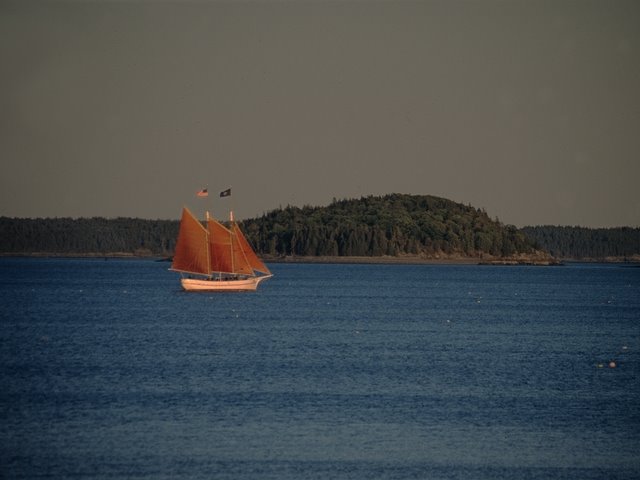
"New England in the Fall" - the subject of a short series of pictures taken on a 3 week Fly/Drive holiday which started in Boston, Mass. and took us for 3,000 miles around Masechusetts, Vermont, Maine, Connecticut and Rhode Island.
It's a particularly distinctive part of America, with most of the place names selected by the English settlers, after their birthplaces. You find Shrewsbury next to Lebanon, next to Chatham and so on. Manchester, for instance, is a very Yuppy, high class small clapperboard town, a bit like Chipping Camden in England.

We wandered up the coast for many hundreds of miles, and the pictures here show some of the sights and locations we saw.
A beautiful place with great seafood, a lovely drawl to the accent, and very polite and helpful people.


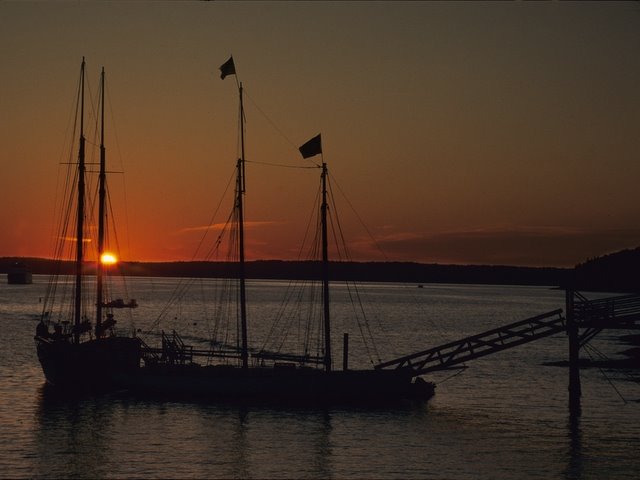
SUNSET AT BAR HARBOUR


YOU'VE GOT TO TAKE THIS WHEN YOU SEE IT!


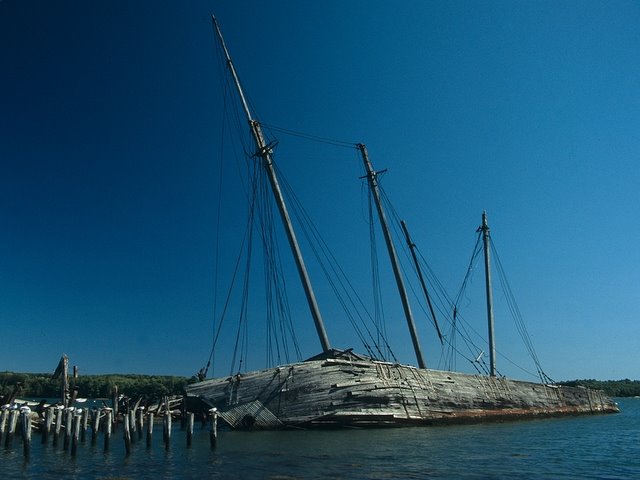
SHIPWRECK AT ROCKPORT


BAR HARBOUR RESTAURANT

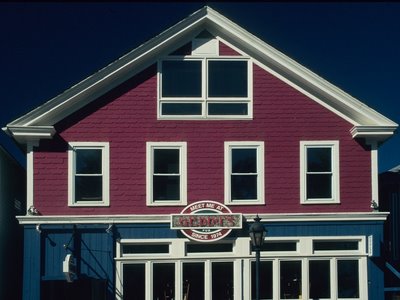
HOUSE FRONT - NEWPORT, RHODE ISLAND

MY GIRLFRIEND'S PUSSY LOVES IT

I suspect I now have your undivided attention.

What I really wanted to talk about was “The Sunday Times”. I have taken it (actually, as we shall see, that is totally the wrong way to say that) for most of my adult life – “The Sunday Times is the Sunday Papers” etc.

This morning, I bought it at the newsagents, making the flippant remark to the girl there – “I don’t suppose, by any chance, they’ve kept the price the same as last week?”, looking for the cheap laugh. She grinned.

“That’ll be £2, Sir.” Last week it was £1.80. Now, I concede that my mind is on the wane, but this ability to keep poking the price higher and higher is truly amazing, and it seems to have been going on for ages. By definition, you don’t keep old newspapers around, so a simple trip to www-land throws up the price in mid 2002 - £1.20. That’s 67% in 4 years – do you know any other business that could get away with that sort of rise?

With a circulation of 1.3 million, that’s nearly £60 million per year – that’ll pay for a bit of increased newsprint cost!

I don’t seem to get anything out of this apart from a slightly larger hole in my wallet each week. So, there’s a deal to be done here. My copy today comes in 14 different Sections, and it’s only as low as that because they’ve combined and rationalised a couple of sections from last week. It also weighs 3lbs 12oz (assuming that the Government still allows me to quote the weight of a Sunday newspaper in Avoirdupois). Yes, I know it’s not a tree in the Amazon, but it’s still a bloody big branch.

What’s the deal then? Now, for reasons I don’t understand, but really am secretly quite pleased about, I can’t stand soccer. And when I want to read about some of the sports which do interest me, I have to flip over what seems like millions, but is really only 20, pages of pictures and stories in the Sports Section, about yesterday’s footy matches. What they should do now is to put all the soccer news in one Easy to Throw Away section just like their sister publication “The Times”, so the 30 seconds I spend each week getting to the Golf bits can be saved in perpetuity.

So, who do I write to?

Oh, and one last thing - about the title of this piece. I was reading about the “Sunday Times” on the internet, and I shamelessly copied the title of one writer’s (phil2001) article for this one, simply because it amused me. He was saying that “The Sunday Times” was the only one big enough to allow him to line the bottom of his girlfriend’s cat’s litter tray for a whole week with - hence the title.

Saturday, September 16, 2006

TUTTI FRUTTI - 20 YEARS ON


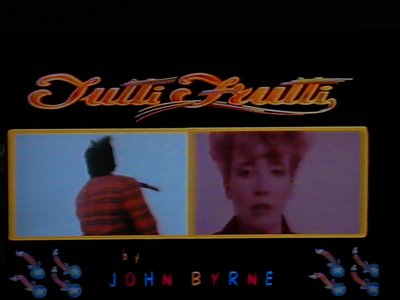
TITLE SCREEN - "TUTTI FRUTTI"

I don’t watch a lot of television, so don’t see all the series which have come and gone over the years. I tend to stumble across programmes, usually by word of mouth, which means my introduction to good programmes starts around Episode 4, when all the character introductions are well in the past. So I normally end up waiting until the release of the DVDs or, in the past, the videos to get the story from Day 1.

If I cast a bit of a personal eye over all the TV drama series I’ve seen since I can really remember, I can only come up with four to which I would unreservedly give Five Stars in my personal list of “Really Great Programmes”.

The most recent is “The West Wing”, which has just played out its final episode, and I still have it recorded to watch. When I’ve seen it, I am sure fingers will be put to keyboard to record what’s so good about it – all 7 years and 156 episodes!

The one previous to that was “This Life”, a fly on the wall style of drama centred on 6 lawyer types and their friends and work colleagues, which caught brilliantly the pace, pressure, tensions and way of life of them all. Jack Davenport and Daniella Nardini, who showed very graphically and frantically in one episode why Canon needed to strengthen the glass plattens of their Photocopiers, head a cast which has become much more well known, since it came out in 1992. Hand held camera techniques, good acting, true to life issues and a really cracking script, pushed it along at a tremendous pace. It was an truly authentic taste of early 90s angst and pressure among the upwardly mobile 25 year olds.

The last two were broadcast in the Eighties – the first being “Edge of Darkness” (1985), a top class thriller which addressed the interaction of the increasing power of global high-tech companies and governments, the police and addressing the long term issues surrounding the ethics of nuclear power and waste disposal. Great cast, great screenplay, the best music soundtrack I’ve ever heard (played very evocatively by Eric Clapton), and a really spooky atmosphere throughout the 6 episodes.

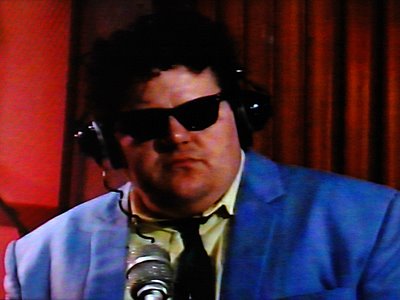
ROBBIE COLTRANE - "DANNY McGLONE"

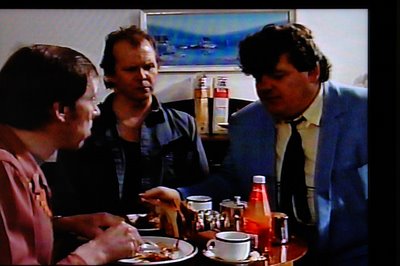
Which leaves the last one, which was shown twice in very quick succession in 1987, and has then not been seen since on TV, Video or DVD for nearly 20 years – “Tutti Frutti”. If you want the best ever example you can find of a real Black Comedy, this is your Man. It’s a story of an ageing Scottish Rock’n’Roll band, the Majestics, who meander their way around the small towns of rural Scotland, playing what they see as their 25th Jubilee Tour. The typical Scottish pastimes are all there, as well as a couple of others like jumping in the middle of the night to your death off a suspension bridge, and self immolation via a can of petrol to get a bit of attention seeking. It sounds dreadful, but if I collect the 10 best Comedy Moments that I’ve ever seen on TV, two of them are in this series. Perhaps it’s me, and I’m just warped.

At the time in 1987, you might be forgiven for not knowing quite who the main members of the cast were, but time has changed that a bit. The lead singer of the Band was one, Robbie Coltrane, his girlfriend was Emma Thompson, and the group’s Manager was a very Victor Meldrew-like Richard Wilson.
Try getting that lot together today.

EMMA THOMPSON - "SUZI KETTLES"

THE MAJESTICS TAKING BREAKFAST

RICHARD WILSON - "EDDIE CLOCKERTY"

Written by John Byrne, it is excrutiatingly good in its toe curling depiction of the downward spiral, the fits and foibles, and the gradually dissolving egos of the four members of the band. Robbie Coltrane is simply brilliant as a very large, but (I’m told!) surprisingly sexy lead singer, who can actually sing. His rendition, towards the end of the series of “Love Hurts”, aimed directly but sung tangentially at Suzi Kettles, his girlfriend, played by Emma Thompson, would hit the top of the charts if someone was adventurous enough to release it – it’s very, very moving. The increasingly manic actions of Eddie Clockerty, the frantic Control Freakish Manager, and Janis, his (very) cynical young sidekick, form another super thread of the storyline through the whole piece.

I’ve written in the past to the BBC, gently imploring them to release this on a DVD, but, in true Public Servant style, they are still composing their reply. The reason this scribble appears today is that John Byrne, the author, has just finished a Musical of the series, which debuts in Aberdeen next week. Rumours, unsubstantiated at present, (but as they say, we’re on the case) are that the problems which have prevented this truly excellent series from being made available to a whole new generation who will enjoy it immensely, have been finally resolved. Hopefully, 2007 will see this masterpiece issued onto a very deserving public.

In the meantime, my precious video copy of two episodes of it is sitting in the player, and I’m just off to live a couple of magical hours with the Majestics.

Rock on, Tommy!