Thursday, April 10, 2008

WELL ANYWAY, IT AMUSED ME No. 23

West Indies are playing Sri Lanka at Cricket today in a One Day International in Trinidad. This picture of Jerome Taylor, the West Indies fast Bowler reminded me of Spike Milligan’s introduction in The Last Goon Show of All as "Spike Milligna, the well-known typing error".

THE CRICKETER AS ANAGRAM

For the life of me, I can’t think why.

Tags:

,

Monday, April 07, 2008

JIM CLARK 1936-1968

40 years ago today, Jim Clark, the best racing driver I have ever seen, was killed.

I've written about him before on this blog, but this day needs my attempt at a tribute.

Was he the best? The truthful answer is – you decide. It is simply impossible to judge the best from one era against the best from another era. Especially in such an arena as Motor Racing, where the changes in technology make such utterly different demands on those who drive the cars. Jackie Stewart, himself a three times World Champion, and one who I suspect believes himself to have been a better driver than he is usually given credit for, sums it up by saying that all you can do is beat those around you when you're involved. And of course he's right. But, it's also the WAY you do it, sometimes quite a mercurial attribute, which puts some champions above the others. But when it's there, it is most definitely there.

In the Sixties, racing a Formula 1 car was a fearsomely dangerous activity. That's not, in any way, to demean those who do it today, but the cars then had minimal safety protection, they were not built with anything like the technical know-how used today, the drivers wore precious little to help them in the event of a crash, there were at best next to no, and at worst no safety services at the races, and the circuits went almost totally unprotected. A run-off area was just as likely to be a forest as a brick wall.

If you had an accident, it was likely to be a big one. Innes Ireland, ex fighter pilot and Lotus driver before Jim Clark, writes very eloquently when he says he left his hotel room on the morning of a race, and looked around, not knowing if he would see it again.

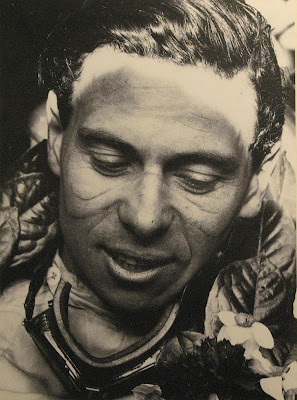
That pressure alone places a totally different mental demand on the driver, and yet they still queued up to do it. The picture below sums it up. Taken at Spa in Belgium, a long, sweeping, fast and dangerous circuit which swooped through the Ardennes forest, the strain of racing shows in his face. The first time he raced there, his team-mate, Alan Stacey, was killed as was another driver, Chris Bristow. Clark came to hate the place yet he still won it four times in succession. That’s courage, as well as supreme skill.

THE STRAIN OF IT ALL

Denis Jenkinson, the best Motor Racing journalist ever, had his own typical forthright view. “Forget the World Championship, just give it to the man who wins at Spa”.

There is an argument that the whole Formula 1 game was not as competitive as it is today, and it's probably true. The rules governing the car's design allowed the shaft of engineering genius to shine through far more than today. But, at the top, the competitiveness was there, be in no doubt. It's just that there were probably 20 people in a racing team rather than the 200+ today. Today it's Toyota, Renault, Mercedes, BMW, Honda, Fiat – then all the teams survived on their racing wits, with no "Big Manufacturer" standing behind them as a safety net.

An elder statesman of the Motor Racing Journalist group has just thrown his hat in the ring and put the cat among the pigeons by writing a book called "Alan Henry's Top 100 Formula 1 Drivers". He has been present at around 600 of the 700 Grand Prix races ever held, and his rankings make excellent reading.

He places young M Schumacher at Number 11.

I can't recall a book on the subject which has got the Motor Racing Blogging fraternity jibbering and foaming at the mouth so much as this list, which after all is just an experienced journalist's view, after a lifetime of watching races. He's not right, just sharing his thoughts with us all.

To him, it is not just points scored which secure your place. Otherwise it would be M Schumacher way ahead of everyone else. His view is much wider – the individual, how he acts, how he drives, the cars he drives, and a much more subtle range of almost emotional issues come into play.

He placed Jim Clark as No. 2 on his all-time list, with Stirling Moss at No.1. I imagine Moss got the nod because Henry thought Clark more often had the best car in the field, whereas Moss indubitably did not. I don’t agree with his order, but so what?

Just to get the statistics on the table, once he had won his first Grand Prix, Clark took part in 56 more Grand Prix races. Reliability then was much more of a lottery than now, and of those 56, he retired from 19, leaving 37 races which he finished. Of those 37, he won 25. That’s 2 out of every 3. He came 2nd only once. For a lot of the time, his team-mate was not a Schumacher style “Rear Gunner” – it was Graham Hill, himself a World Champion. I can’t actually be bothered to check out the whole of Grand Prix History, because I can’t think of anyone with a record remotely like that.

Clark was a strange man. He was born into Scottish Borders farming, and although he undoubtedly changed as his Motor racing life took him over, you felt he never lost sight of this background – as far removed from a Grand Prix driver as you could imagine. He seemed to be an introverted, manically nail chewing, almost reticent individual out of a car. Inside one, he was hard, disciplined, sensitive, the smoothest of the smooth drivers, and supremely fast.

He was a Pole Position specialist, and his racing style was simply to blast away at the start, immediately get a dominant lead, and leave the remainder of the field to fight for Second place.

The sixties were also times when there was no such thing as a Grand Prix Driver. They drove everything. Clark raced large American saloons, Formula 2 cars, Indianapolis Speeedway, Sports Racing cars, Le Mans, “David and Goliath” Lotus Cortinas (see below for a picture which shows what that involved!), as well as taking part in the 1966 RAC Rally.

NOW THIS IS RACING! - CLARK IN A LOTUS-CORTINA


It was this dichotomy between the type of man he was off the race track, and the man whose driving defined the racing era he lived it which has been the source of so much fascination. Most of his peers put him in a different class from the rest, and they should know.

Chris Amon (No 13 on Alan Henry’s list), summed up what Clark’s loss meant - "If this can happen to Jimmy, what chance do the rest of us have? I think we all felt that. It seemed like we'd lost our leader."


Photographs borrowed from Eric Dymock - Jim Clark Racing Legend

Tags:

,
,
,,

Sunday, April 06, 2008

WELL ANYWAY, IT AMUSED ME No 22

So there I am watching India play South Africa at cricket. The commentators are Graham Thorpe, an Englishman, and Kepler Vessels, a South African – both great players in their prime. It’s fair to say we’re watching India get comprehensively destroyed, as they try to recover from an amazing brainstorm where they’d managed to amass 76 runs in their first innings, with South Africa declaring their own first innings closed on 494 for 7.

In the middle of the play, we see four men, an umpire and three players kneeling on the ground peering at the turf. We can’t see what they’re looking at, but it is obviously attracting their full attention.

Graham Thorpe – “What is it?”

Kepler Vessels – “It’s a pig.”

Graham Thorpe (Snorting, I was going to say, but am not going for the cheap laugh here – Cricket is serious stuff) – “It’s not a pig!”

Now we’re getting a grandstand view of the scene of the crime with a close-up of the four guys kneeling on the ground. Trust me, a pig was nowhere to be seen. I know what pigs look like.

So, the four men confer, and somebody shouts to one of the ground-staff to bring something onto the pitch. An Indian guy duly runs on with some tools, bends down, and attacks the ground, extracting something which had been holding the covers down on the previous day when it had rained.

“There you are,” says Kepler Vessels – “it was a pig, a tint pig”.

Graham Thorpe wisely said nothing.

Tags:
,

Monday, March 31, 2008

LESLIE PHILIPS READS WILLIE FOWLER'S "COUNTRYMAN'S COOKING"

One year and 9 days ago I wrote a piece on a Cookery Book, of all things. Written by the snappily named William Menzies Weekes Fowler (or Willie to his friends), and called “Countryman's Cooking”, it is an absolute humdinger of a book.


THE NEW COVER FOR THE BOOK

Published in 1965, it immediately bombed, but was re-discovered by one David Burnett, a “one-man band” publisher from Ludlow, who re-published it in 2007. It is gloriously un-politically correct, hugely self opinionated, brilliantly sexist, hilarious, and also an extremely good cook book.


WILLIE FOWLER, IN TYPICAL POSE

My Brother in Law, who, in Golfing terms, plays off about Scratch for his Cooking Handicap, has cooked me a couple of his recipes, and they are terrific – try his Beef Olives, and throw Delia to the dogs.

If you can find your way back to 22 March 2007 in this blog, you can read what I said then. The reason for bringing it back to centre stage today is that the BBC, bless them, have recorded edited excerpts from the book, and are broadcasting them at 3.30pm each afternoon (Monday-Friday) this week on Radio 4.

I don’t know who selected the reader, but if they’d sat for 100 years trying to improve on their choice, they’d have failed.

Leslie Philips, louche, debonair, caddish, need I say more, works his way through Fowler’s witty tome – spot on. A few minutes of pure joy each afternoon. If you can’t get to a Wireless Set, then chase it down on the “Listen Again” feature on the BBC Radio 4 Website.

You will not be disappointed.

Tags:
,,,

Saturday, March 29, 2008

I'M DREAMING OF A WHITE EASTER .....

What could be nicer than a gentle, lazy Easter spent on the coast in Norfolk. Ice cream on the harbour-side in Blakeney, a stroll along a deserted beach in the spring sunshine, and generally noodling around doing not a lot.

Yes well, best laid plans of mice ….. and all that.

Freezing temperatures, ferocious winds, halestorms, blizzards and white-outs were the order of the day. Whoever dreamed up the idea of Global Warming should have been with us on Easter Sunday and Monday.

Anyway, being English, the walk on the beach went ahead, leaning at about 45 degrees into a raging snowstorm and the next day, following 6-7 inches of snow at Felbrigg, we took the dogs to play, and had a very Christmassy Easter snowball fight in the bright sunshine.


THE CALM BEFORE THE STORM ON WEST RUNTON BEACH


SNOWSTORM ON WEST RUNTON BEACH

Felbrigg is a lovely National Trust owned house and park, with a large forest, all totalling around 1,700 acres.

With a very impressive Jacobean fronted house, it has had quite a turbulent history, finally ending up in the hands of a gentleman named Robert Ketton-Cremer. The original heir, Robert Ketton-Cremer's brother Richard, was killed in action in the Second World War, and a memorial to him was constructed in the woods behind the house by Robert. The house was passed onto the National Trust just after the end of the war.

A large Victory V has been created in the forest area by removing two vast swathes of trees, forming a lovely shaded walk. A solitary bench located at the apex of the V rather poignantly commemorates the loss of his brother, as well as celebrating the Victory in 1945.


BUILDING AN EASTER SNOWMAN IN FELBRIGG

CYCLING THROUGH THE GROUNDS AT FELBRIGG


We have seen the place in many varied conditions. Blazing summer sunshine, glorious Autumnal colours, pouring rain and now glistening snow.


LOOKING TOWARDS THE APEX OF THE VICTORY V

LOOKING DOWN ONE OF THE TWO AVENUES OF TREES

IT LOOKS A BIT DIFFERENT IN AUTUMN


Good old Mother Nature.

Tags:

,
,
,,

VIRENDER SEHWAG'S STUNNING INNINGS


SEHWAG, CAUGHT BRILLIANTLY BY A "SUN" PHOTOGRAPHER

Regular readers of this tiny corner of the Internet will by now, have picked up on my love of cricket. Having just watched England, over the last few weeks, dutifully beating a depleted New Zealand team, the interest has now switched to a “Top of the Table” Test Series in India, where the home side takes on South Africa.

If you assume that Australia are still the best side in the world (and I’m actually not quite sure about that), then you’d probably say that this series is between the second and third best sides in the World at present, playing to become heir apparent. So there’s a lot to play for.

Day Three of the First Test has just finished, and I’ve just watched the most blistering innings I can ever recall. Over the first two days, South Africa fought their way rather effectively to a tremendous score of 540. Alright, it was on a batting paradise of a wicket, but it still left India a massive psychological task to knuckle down and match such a huge score. If it had been England under the cosh, you would have worried every ball about a batting collapse, to be followed, as night follows day, by a humiliating Follow On.

Not India - they’ve just finished the day at 468 for 1 wicket, with Virender Sehwag unbeaten on 309. Triple centuries are very rare beasts, and on a day when temperatures were stratospheric and the humidity was a bit like a sauna, Sehwag blasted his way to his 300 score in 278 balls. This is the fewest ever in Test cricket, beating Wally Hammond’s record which has stood for 75 years by an unbelievable 77 balls. If you don't accept Hammond's record, where the number of balls was estimated, then the next best is Matthew Hayden, at 360 balls. Just do the maths, and marvel!

TAKING THE PLAUDITS - HE PLAYED FLAWLESSLY

To my simple mind, when this guy is “on song”, he is the most exciting batsman on Earth, only Sri Lanka’s Sangakkara being remotely comparable. He hits the ball all over the ground with an arrogant ferocity which must put the fear of God into any opposition captain. You could see the despair in the bowlers – there was nowhere on the pitch they could bowl that was safe from him. So far in this innings, he's hit 41 Fours and 5 Sixes. As a comparison Alistair Cook, England's opener, hit his first Test Cricket Six ever (out of nearly 3000 runs) in New Zealand the other day - and that hit was a fluke top edge over the Wicket keeper!

And this all came from a man who is not sure of his place in the team! A very revealing comment from him after the day’s play shows just how much difference there is in the mindsets of Sehwag and several of the current England batsmen. When asked how he managed to concentrate (he was batting all day and some of yesterday, with almost no errors made) – “It hurt when I was not in the team so I had to prove myself and I want to get back my seat so that's why I can concentrate and it's good for me and I think I'll continue in the next two Tests." I bet that makes South Africa really happy.

Goodness knows what awaits us tomorrow, as India need to carry on, still trailing by 72 runs. If things go well for them, you could easily see them carrying on for most of another day, with the mouth-watering thought of Sehwag playing the highest Test scoring innings ever. He only needs to score another 92 runs – about 10 overs at the rate he can score, if he gets going! And if you want to look at another record, India were the team on the end of a farcical score of 952 for 6 (it’s the 6 wickets that that makes the knife really twist), made by Sri Lanka 11 years ago, so they might even think of getting that record erased if they think a draw is likely!

From South Africa’s viewpoint, you could feel their demoralisation when they saw what they thought was their dominating total of 540 being taken brutally apart by some of the most inspired, and inspiring hitting you will ever see.

It was an absolute joy to watch. Thank goodness for my Sky+ box. It’s just gone Midnight, and I’m going to sit through it again.

We need to get the England team to watch it all. Actually perhaps not. This would blow their confidence wide apart, and with India visiting these shores in a couple of months for a Test Series against Mr Vaughan and his Merry Men, I think we’re going to need all the help we can get.

Tags:
,,,

Wednesday, March 26, 2008

ARTHUR C CLARKE AND "2001"

The film 2001: A Space Oddysey has been in my personal Top Three Films of all time for 40 years, and I guess it will probably stay there now for ever. Sometimes, I think it's the greatest film I've ever seen, sometimes a couple of others poke their noses ahead of it, but it sits there as a film that's probably affected me more in total since it was released in 1968, than any other. It was triggered off by Arthur C Clarke, who died a couple of days ago.

Here was a man whose mind was uniquely suited to the description "far-sighted". He had a remarkable ability to predict the way of technological things to come, and reading his prolific output, you are continually surprised at how often he got it right. It was the ways of science, and often its relationship with God that kept him enthralled, and productive, for all his life. No-one would accuse him of having an overemotional writing style, and indeed, the dedication to his book "Report on Planet Three" alludes to this. His own view of his place in science writing vs. science fiction writing is addressed here – "In accordance with the terms of the Clarke-Asimov treaty, the second-best science writer dedicates this book to the second-best science-fiction writer." I think he got it the wrong way round, but there you go.

His now classic 1945 article for Wireless World predicated the possibility of geosynchronous orbiting satellites, and set going the reality of the way global communications work today. He apparently received the princely sum of £15 for this bit of writing, and I only hope that, somewhere along the way, Rupert Murdoch remembered to give him a free Sky subscription and dish, as a bit of a thank you.

2001 started out as a rather innocuous 12 page story, first published in 1951, called "The Sentinel". It was entered in a BBC competition in 1948, and failed to win. This short tale however changed his, and in the event, many other people's lives. It was read by Stanley Kubrick, who sought him out, wanting to create a science fiction film. Kubrick dragged Clarke into telling him everything he knew on the Science Fiction side of things, and the slow, rather painful gestation of the film got underway.

The nub of the story is Clarke's supposition that an alien intelligence, far more advanced than ours, might have left a series of inter-galactic "alarm clocks" throughout the universe. These were triggered to go off if the nascent form of intelligence the aliens came across on their travels developed to such an extent that they set the "alarm clock" off. In Clarke's story, the machine was placed on the Moon's, defining clearly the achievement needed if the early form of life on Earth was to pass its test.

Clarke and Kubrick developed the story enormously, extending it as the longest prequel in History, to some three million years before the monolith was found, and also tracking the subsequent actions taken to follow up the monolith's discovery.

When the film was released, which was only a year before Man actually set foot on the Moon, it became a cult focus very quickly. Nothing at all had been seen like it before. I recall seeing it, at a large 1,500 seater cinema in Bedford, in 70mm film, with the screen totally filling my field of vision – a bit like an Imax today. In 1968, it was truly awesome. From the opening sequence of the blazing sounds of Strauss's Zarathustra theme playing out over the almost religious conjunction of the planetary sun-rise, you knew immediately you were in for something unique. It was a cinematographic tour-de-force, which culminated in an abstract, thundering rush down into a technicolour "Star-Gate", which got all the pot smoking contingent in the late 60s really worked up.

To this day, I don't think Clarke actually knew how to end it, and that is one of the reasons why it sticks in your mind. There are many possibilities about the "meaning" of the film. Clarke described it as a "Religious Myth", and clearly the possibility that the aliens were actually God, remains a strong contender, although in the original short story, Clarke surmises that the aliens may well not be particularly nice to know. There is something about a real thread of ambiguity in a film which keeps it at the top of my personal list. "Lawrence of Arabia" is another film capable of various interpretations, and that is also ensconsed in my Top 3.

It's not an easy film, and Kubrick's langurous, measured and idiosyncratic style left some people bored. Any film where both the first and the last 20 minutes have no dialogue whatsoever, can very easily polarise critic's views. And what dialogue does occur is, I suspect very intentionally on Kubrick's part, drab, boring and banal.

However the combination of an utterly fundamental storyline, some fantastic visual imagery and a very "left-field" classical music score – who ever would marry a Space Station slowly rotating through deep space to the sounds of the Blue Danube? – works to the point of perfection. The first time you see it, it makes you gasp.

In some ways, it's not a people film. Apart from Keir Dullea, and "Rigsby", who showed the dangers of type-casting only too well to those in the UK who watched "Rising Damp", can anyone name any other actors in the film?

Exactly.

In some ways, the main "actor" in the film is HAL, the ship's computer, whose soft, gentle voice (actually Douglas Rains) makes you feel almost sorry for it, as it logically and rather mercilessly, sends one of the crew to his death, and then regresses to some form of childhood as Dullea emasculates its memory.

But the film is not about people, it's about ideas, and the deliberate lack of emotional content brings those ideas and thoughts fully to the forefront. Like the other great "epics", it doesn't show at all well on a small screen. Each time I've seen it, has been on a huge Cinema screen, and the impact of size is fundamental to the way the film comes across. You need to be overwhelmed by it.

As Clarke said, the original story was "an acorn", and the final film was an "oak tree". If it ever comes to a "cinema near you", go and see it – it's magnificent.

Tags:

,
,
,,
,

Friday, March 21, 2008

MARKETING - FIRST IDENTIFY YOUR TARGET AUDIENCE

The ASBO scheme (Anti Social Behaviour Order) has been a jewel in the armoury of our present Government’s approach to controlling the less seemly side of this country’s inhabitants since the scheme’s introduction in 1999.

Most of the nearly 10,000 ASBO’s issued to date seem to have been given to individuals in the large urban conurbations, but they now seem to be spreading – see the picture below which was taken in central Shrewsbury a couple of days ago in a Town Centre shop window.


Perhaps not quite what the Government had in mind.

Also, along similar lines, I came across this extract from the “Bucks Herald” a couple of days ago -

A PENSIONER from Aylesbury has pleaded not guilty to two counts of breaking an anti-social behaviour order which prohibits him from interfering with cyclists in the Vale.

A*** P*****, 74, of Eleanor Gardens, Aylesbury, appeared before Aylesbury Magistrates Court this morning (Thursday March 13). It is alleged that on February 10 he caused a cyclist to stop on a footpath by moving into his way and raising his hands, and that on February 29 he stood in the path of a female cyclist causing her to swerve and that he waved his arms.

He had been prohibited from stopping, by verbal abuse or physical actions, any cyclist on any public footpath or in any public place within the jurisdiction of Aylesbury Vale District Council until December 3 2009.

P******, who has refused to be legally represented, will be tried on June 6 at Aylesbury Magistrates' Court.

A pre-trial review will be held on May 12. He was granted unconditional bail.

His ASBO remains in place.

Tags:

,

Tuesday, March 11, 2008

ENGLISH CRICKET - THE OXYMORON

Having spent the last 5 days incarcerated at home, feeling “One Degree Under”, or more accurately Four Degrees Over, I have spent more time than usual in front of a TV screen – not all of which has been good for one’s health.

Having watched the English Rugby Team zealously extend their run of staggering incompetence, the next day I turned to Michael Vaughan and his colleagues in New Zealand to restore my flagging belief in English sporting prowess. While the Rugby team were doing their thing, the England Cricket team had been on a high, ripping through the New Zealand team in a way we haven’t seen for quite a while, leaving it all to play for on the last day – at last, proper Test Match Cricket.

I ended up watching most of the last day’s play from behind the sofa. It is really despairing when, one player excepted (Ian Bell), the whole of the team managed to put on such a display of concerted ineptitude, that you wonder what is really at the bottom of such a performance. There’s not a world-class player in the team (Yes, I know Pietersen was playing), but they can all hit the ball, and score runs. They were “only” playing New Zealand for goodness sake. The reason behind their abject display had to be something different. You could understand it if they’d gone down fighting, but it was a performance of resigned gutlessness, the like of which I haven’t seen for a long time.

Because the match ended so early on TV, there was a good deal of time to fill so Sky, in a move of exquisite cruelness, played a match by match recording of England winning the Ashes in 2005. Here we had many of the same people, Vaughan, Strauss, Harmison, Hoggard, Bell, Pietersen, playing cricket as if they believed themselves to be individually and corporately the best in the world, and completing (albeit just!) one of the most joyous sporting triumphs ever.

Yes, names like Trescothick, Flintoff, Giles, Simon Jones are not there anymore, but the chasm between the attitude in 2005, and the display in Hamilton on Sunday was enormous. On Sunday, even someone normally as positive as Pietersen seemed resigned to failure, offering all the reasons under the sun why the pitch, the opposition, the weather, anything he could think of actually, were all a bit too much to make a win at all possible. Perhaps the coach should stop all the techno-babble which pervades England’s game today, and sit them all down and force them to watch that Ashes film, and simply say – “That’s how you do it.”

As a complete contrast, look at how India, in a fascinating and compulsive series of Tests and One-Dayers in Australia along with Sri Lanka have grasped that particular nettle. They’ve had the bold foresight to pick a new captain in Dhoni, who has insisted on new blood in the team, binning several of the old-timers – but not you will note Tendulkar. He’s got the new boys picked, and has not hidden them away, but thrown them the ball and the bat, and said “Go on then- prove yourself”. And they have. The injection of youth has meant their fielding has improved enormously, and their batting has worked better than any of the opposition – the top 3 run scorers in the competition were all Indian, and in the bowlers they have found some great new stars.

The most exciting cricket of the summer occurred after watching Ponting, one of the World’s very best batsmen, losing out time and time again to Harbhajan, the Indian spinner. After a very acrimonious Test in Perth, either by fair means or foul Harbhajan was excluded from the next game. You could almost hear a palpable sigh of relief, the next time Ponting walked to the middle, knowing he couldn’t be dismissed by his bete-noir, only to face a new, raw, untested 19 year old fast bowler, Ishant Sharma. Sharma bowled 9 overs at him and, in the best spell of intelligent, aggressive fast bowling I have seen for ages, made Ponting look totally inadequate and decidedly second rate (which he isn’t), until falling victim to him. It was utterly compulsive viewing, and a real gem of a sporting moment.

As a contrast, we get two England senior fast bowlers, Hoggard and Harmision, who both start a Test Series woefully underprepared, and who both spectacularly fail to deliver. Quite what Ryan Sidebottom, who grabbed 10 wickets in the match thought about it must have thought about it is not known, but you could probably make a shrewd guess. All we heard in response from Harmison was he had stayed in England to be present for the birth of his fourth child – and the cricket came second.

Well fine.

These guys are on fancy contracts, which, if you believe the newspapers, means they are being paid £300-400k per year, before bonuses and sponsorship. I have no problem with sportsmen earning big bucks, but the deal is simple. You get the money, we get 100% of you, body and soul. If Harmison, who has already backed out of One Day cricket for England, wants to spend more time with his family, than he can go back to the county ranks and do precisely that. This is a man who, in the 2005 Ashes series reached No.1 in the world. Here he looked more like someone wanting to discuss his offspring's Knitting patterns, rather than someone looking to put the fear of God into Daniel Vettori’s men. Fast bowling is about attitude – look at the West Indians in their heyday, look at Lillie and Thompson, Trueman even – men who frightened you before you even got on the field.

Harmison’s time has gone. We need to take a leaf out of the Indian’s book, and at least put people in the side who want to give their all to play for the country. The next Ashes series is coming at us more quickly than you think, and we need a team with belief in themselves. You might get another Sidebottom – heaven knows we need one.

And I haven’t even got onto Kevin Pietersen yet!

Tags:

,
,
,

Thursday, February 28, 2008

IS NOTHING SACRED IN GOD'S HOUSE?

A couple of items ago on 3rd February, I wrote a short piece about York – specifically the Minster and Bettys, feeding (in no particular order) body and soul. A few pictures taken in both places, enlivened, or at least padded out the words.

Lo and behold, last Saturday’s Daily Telegraph (for those of you not in the UK, the Daily Telegraph is the UK’s premier national daily newspaper – unless you are the editor of the Times, in which case, it’s probably the Sun) had a picture which had me checking back to my own photographs. An almost identical image to mine, of the roof of the Chapter House (that’s in the Minster, not Bettys) appeared in the newspaper.

THE TELEGRAPH'S PLAINLY PLAGIARISED, OFF-CENTRE AND POORLY ANGLED VIEW OF THE CHAPTER HOUSE ROOF PUBLISHED ON 23 FEB

MY MASTERPIECE OF THE SAME SUBJECT TAKEN
AND PUBLISHED HERE ON 3 FEBRUARY


Now I took the image by lying flat out on the stone flags with my head at the centre of the circular floor looking vertically upwards. I must have looked, I suspect, very much like the leader of the provisional wing of some Druid Cult in the throes of a rather dark and mystical ceremony that could easily have been mistaken for some preliminary planning for Wicker Man II.

Some few days later, the bemused staff there must have been intrigued by another wierd-o doing exactly the same on the Chapter House floor.

I wonder what they think is going on.

I suspect security there now is a lot tighter.

Tags:
,
,
,,

Tuesday, February 26, 2008

THAT'S ANOTHER CUP OF COFFEE DOWN MY UNIFORM, MAVERICK

“Good afternoon, Ladies and gentlemen, and welcome aboard the Maiden flight of Cathay Pacific’s new Boeing 777. We hope you are all enjoying the experience. We are currently flying at 300 knots, and our altitude is 28 feet.”

A Glorious piece in the paper yesterday showed a still from a bit of YouTube footage with one of Cathay Pacific’s new Boeing 777s taking the Great and the Good of the Airline up for a jolly. The only problem was that the pilot, one Captain Wilkinson, decided to give the passengers a flight they would remember for the rest of their lives by blasting down the runway, wheels up, at what has been measured at 8.5 metres off the ground. I suspect the passengers’ feelings about this strafing run will be rather dependent upon whether the pilot informed them about what he had planned for them before he did it.

You can’t help but imagine that Captain Wilkinson must be a closet Tom Cruise/Top Gun fan, and, instead of fixating in that film, as any real man should do, on the straightness of Kelly McGillis’s stocking seams, he must have seen a once in a lifetime opportunity to respond to the “Top Gun” line when Cruise asks permission to buzz the Tower - “That’s a Negative Ghostrider, the pattern is full”, knowing that he was in a uniquely good position to copy his hero’s subsequent antics.

The airline, as you might rather depressingly expect in today’s environment, did not take too kindly to all this, although it does not seem to be the people on board who whinged about it. Putting a video of it on YouTube seems to have done for him. In an internal review lasting a week (!), the suits in the Airline decided to sack him.

Given the buckets of free publicity he has generated for the airline, I’d have thought they’d have promoted him to Head of Marketing, but maybe I’m missing the point here.

But when you read the Airline’s press release, you start to get that “here we go again feeling”. The spokesman droned out “ …. was dismissed as he had neither sought nor obtained the necessary company approval to undertake such a fly-by.” Actually, looking on the bright side, it doesn’t say that he wouldn’t have got it if he’d asked, so maybe I’m being a bit down on Cathay Pacific, and they may be less stuffy than you’d think.

A Cathay Pacific “insider” who is also interviewed says “He decided to give them a flight they would never forget (I think he’s right there), but why he chose to do it with the chairman on board (whose surname is Pratt, if you’re interested) is anyone’s guess. ….. Maiden flights are treated as a bit of a jolly for executives with lots of champagne flowing, and these fly-bys used to be done for a wheeze in the old days. But they are dangerous, because however good the pilot thinks he is, he isn’t trained for it, and the planes aren’t designed for it.”

Hang on a minute – we’re talking about flying in controlled conditions close to the ground here. Now call me old fashioned, but I want my pilot to have the maximum possible experience in flying feet above the runway. Most of the accidents I read about seem to occur quite close to terra firma. If Cathay Pacific isn’t training its pilots to fly close to the ground, or it’s buying aircraft that are uncomfortable near it, I think a different airline is called for, irrespective of how gorgeous the Stewardesses are. If you want to see why I want these guys to know what they’re about, just look at this landing of a 747 at Hong Kong.

A GREAT VIEW OUT OF THE PORT WINDOWS!

It’s things like that make me admit I’m not the greatest fan of flying. I can’t rid myself of the nagging thought, when I’m up there, that every single component of the aeroplane I’m flying in was purchased from the supplier offering the lowest cost. And, despite (or perhaps because of) the fact that I’ve got a Degree in Aeronautical Engineering, I’m still not totally convinced that the reason planes get off the ground has got anything to do with Aerodynamics – I think it’s all to do with the exponentially increasing collective focus of every passenger on board willing the plane into the air after its acceleration along the runway.

The real clue to this story is in what the “insider” said. These things go on all the time, and the freedom we now have to put everything on the internet has here resulted in a case of The Law of Unintended Consequences taking its toll.

If you want a classic example of the ways of the past, look up the following link to find the doyen of test pilots, Boeing’s Tex Johnson http://www.aviationexplorer.com/707_roll_video.htm, who during the test programme of the original Boeing 707, performed a barrel roll in one at a sales demonstration. There’s a grainy video of it happening, with a great still picture of the aeroplane flying upside down over Lake Washington, as well as a beautifully underplayed commentary from the great man in his laconic American drawl. The boss asks him on the Monday after the event, what he thought he was doing. “Selling aeroplanes” was Johnson’s classic answer.

He kept his job, and they immediately stated to sell shed-loads of 707s.

Simple really.

Tags:


,
,
,

Tuesday, February 19, 2008

WELL ANYWAY, IT AMUSED ME - No. 21

My daughter's new chickens, who are now keeping their side of the bargain by producing some truly excellent eggs are about to move into their second home. This is being protected against the weather by a couple of coats of paint and varnish.

This is the pot of varnish being used -


- And this is the disclaimer on the back.


Tags:
,
,

Wednesday, February 13, 2008

A SHOT IN THE DARK - NORFOLK FASHION

Up with the lark this morning. There’s something creepily virtuous about getting up on a Sunday in the dark when you don’t have to, and you could be having a lie in instead.

The weather forecast here in Norfolk was very good, the tide was right, so off to take some pictures. Wandering around the estuary at Morston, a small sailing village, as the sharp, morning light spread slowly across the water and climbed its way up the sides of the boats moored there, was one of those magical moments which make you feel good to be alive.

Having taken a few shots, I drove into Wells to wander along the front, and find some breakfast. I ended up with the Anglo-Italian fusion of Toasted All Day Breakfast Panini, and a large Espresso, from the local Deli. As I chomped my way through this, a Police Car appeared and parked on the open space next to the quay. It was quickly followed by an ambulance, which in turn was followed by a Fire engine.


THE CLANS GATHER

The crews all got out, quite relaxed and chatting away. I know life in this part of the world is a bit Manana-ish, but your first thought was that with what was clearly quite a sizeable emergency unfolding, a bit of zip wouldn’t have gone amiss.

Then the Coastguard boat, fully manned, “Shipshape and Bristol fashion” chugged around the channel and moored, followed by the fully kitted-out Lifeboat crews ambling up to have a chat with each other.


THE WELLS LIFEBOAT AND CREW

Then the local Community Police girl (disarmingly pretty, I have to say) on her designer bike, and her equally disarmingly unpretty male colleagues on their machines. Then a shoal (don’t know collective noun for) of Flood Wardens arrived, one wearing a very rakish Bush-Wacker hat, at the same time as a large orange and professionally equipped Rubber Dinghy.

NOW THAT'S WHAT I CALL COMMUNITY POLICING


By which time it dawned on me that all this was in all probability not the result of a local resident’s emergency call. Especially when a guy erected a ladder at one end of the quay, climbed up it and got out a loud-hailer and a camera.

CREATING ORDER FROM CHAOS


As the minutes passed, a massed gathering of the Norfolk Rescue Clans came together, increasingly obviously now to have their pickie taken. There seemed to be an awful lot of them, and if the chaotic way they milled around as the poor photographer tried spectacularly unsuccessfully to create at least a veneer of order is anything to go by, then having your accident in the next county would seem to be a prudent self-help strategy. I suspect though, that when it’s serious, and they move into action properly, you’d see a very different side to it all, but on a lazy Sunday Morning, it all seemed like someone trying to herd cats.

STAND STILL OR I'LL SHOOT YOU

The photographer had me totally transfixed – he moved everyone backwards, forwards, sideways and back again. He seemed to have them putting their helmets on, taking them off again, turning sideways, looking to the front, not picking their noses and generally trying, without any visible success, to get them to behave like honourable, grown-up members of the county’s accident and recovery structure system. But as time went on, the cast showed a slowly collapsing level of interest (actually not very much at all), and when he announced that “the helicopter” would arrive in 15 minutes, there was a communal groan and he lost them completely. They had 10 minutes at least where they could simply chat to their mates or try to get off with the female Police Officer by asking her intense, searching technical questions about her bike.


UNDIVIDED ATTENTION AND .....


..... TOTAL COMMITMENT


After the 15 minutes, exactly on time, the helicopter appeared, very “Apocalypse Now”, low on the horizon, and all we needed was a decent military band to strike up “The Ride of the Valkyries”, and, in my eyes at least, the day would have been complete. But Ford Coppola he was not. The photographer raised his loud-hailer to try to tell the helicopter pilot what he wanted to do, and suddenly dropped it, realising the pointlessness of what he had just done and clearly hoping that no-one had noticed.

The helicopter could only fly slowly past, since hovering at the most appropriate spot was apparently not allowed, so the photographer only had one go at getting his picture. With exquisite timing, we now had the glorious sight of some slightly disorganised old gent, who clearly had no idea of what was going on, deciding to walk slowly and painfully with his stick across the front of all the carefully orchestrated groups. He’d got halfway across before our snapper noticed him, and a couple of helpers tackled him to try to bundle him off the set before the helicopter arrived a few seconds later. He did a pretty good “Mr Bean” impression, except in this case you knew that he really didn’t know what was going on.

THE INTRUDER DEPARTS


It probably reflects very badly on my image as a nice, caring person, but I found all this utterly hysterical. The frantic jibbering of our man on his ladder when he saw the intruder was an utter joy to see.

The rest was, in all honesty, a bit of an anti-climax. The helicopter swung its way past, our man pressed the shutter, and he asked a henchman, who, one assumes had “Walkie-Talkie” contact with the helicopter pilot, to get him to go round again, which he did. Everyone said a communal “Cheese”, and our intrepid snapper had the luxury of two bites at this particular cherry.

I have to say that, when it was all finished, they all looked very professionaI, and gave a real sense of comfort that if you got into difficulties, there was a real team waiting to help you out. As far as the photographer was concerned, I
only hope he’d remembered to put a new Memory Card in his camera, and charge the battery.

Tags:

,
,
,

Sunday, February 03, 2008

FEEDING THE INNER MAN IN YORK

York is a terrific city to visit. I should know – I spent about two hours there last week. The weather was awful, the wind was blowing a gale, it snowed, and then rained. So my visit consisted of a whistle stop blast round the Minster, followed by lunch at Bettys.

If you’ve never been to either, take my advice and go. The Minster is awesome, and I do mean awesome, and Bettys takes an awful lot of beating for an excellent meal.

The Minster itself is the second largest Gothic Cathedral in Northern Europe, with an outstandingly beautiful set of Stained glass windows, the East Window being the largest in the World. The church there dates back to c 300 AD, but the present building was started in 1220, and “declared complete” and consecrated in 1472.


YORK MINSTER - THE CENTRAL NAVE

Admiring the building through my untutored eyes, it is incomprehensible to imagine what an average person from Rural England must have thought the first time he saw it in the Early Middle Ages. Even today, the size is intimidating.

The other immediate impression is the quality and quantity of the detailing. It is all of the highest quality, and ranges from 13th Century effigies to a magnificent Astronomical Clock installed in 1956, commemorating the Airforce Crew who were stationed around the area in the Second World War.

STAINED GLASS WINDOWS AND VAULTING - CHAPTER HOUSE

VERTICAL VIEW OF THE CHAPTER HOUSE ROOF


DETAIL OF THE CHOIR SCREEN

DETAIL CARVING - ONE OF LITERALLY HUNDREDS!

This remembrance of the Second World War jumps out again in Bettys, where the inner man benefited from a Seafood Linguini, a steamed Ginger Pudding, and a cold lager.


BETTYS - INTERIOR SHOT

Downstairs, a large mirror is covered with signatures from airmen who were stationed at the surrounding airfields in the early 1940s. Bettys in York was the unofficial “Ops Room” for these men, and those that survived and have returned to York in the last 60 years are invited to sign the mirror with an engraving pen.


THE AUTHOR PHOTOGRAPHING THE MIRROR IN BETTYS

There are 600 names there. Quite moving.


Tags:

,
,
,

Tuesday, January 08, 2008

SLEDGING PUTS CRICKET ON SLIPPERY SLOPE

I have spent the last few days swanning around in Norfolk, walking the dogs on the beach and generally doing not very much. Apart, that is, from ringing work colleagues up to ask them what they are doing, and timing how long it takes for the torrent of abuse to start.

As anyone who reads a newspaper will now be aware, Australia played India in the 2nd match of a Test Series over the last few days. I (or more precisely my Sky+ Box) spent the nights diligently recording the play live, and I then spent the days, and the aptest word here is undoubtedly INDOLENTLY, replaying the action. I have to say, if you’d watched it as a Cricket match, with the sound turned down, you’d have got to the end with extremely mixed feelings, but having watched a real Roller Coaster.

It was a very, and I mean very, exciting match which veered, and on occasions careered, from one side to the other remarkably quickly. Firstly Australia, down and out at 134 for 6 (out of which please note – Ponting lbw bowled Harbhajan Singh - 55), ended up making a further 329 runs before their last wicket fell at 463. Andrew Symonds played a majestic, mature, intelligent and remarkably responsible innings ending up with 162 Not Out. The only real problem from the Indians viewpoint was he was unarguably out to a thick edge when he was on 30. But there you go – that’s cricket.

The Indians were 1 down for 8 runs, and you thought – here we go. Dravid scraped his way rather agonisingly to 54, and was given out wrongly, and badly wrongly, by Umpire Bucknor. But VVS Laxman made an excellent 109, and Tendulkar, who, it must be said, struggled at first, but played with terrific grit, concentration and flair in the end, ended up brilliantly unbeaten on 154. Harbhajan Singh (it’s him again), their off-spinner, added 63 runs of his own, in a great 8th Wicket partnership of 129. I love watching the fielding side getting increasingly pissed off when the rubbish tail-enders put a really good score together. The Indians, extremely unexpectedly, ended up with 532, 69 ahead of the home side.

Australia went at it again in their second innings, and seemed to bat for ever. They got to 250 for 2 (including Ponting c Laxman b Harbhajan Singh – 1). With good centuries coming from Mathew Hayden (123) and Mike Hussey (145 Not Out), they crawled up to 401 before declaring, leaving India to get 333 on the remaining part of the last day, in very short order. Once again in the 2nd Australian innings, the Indians must have felt the umpire was playing 12th Man for the Home Side when he gave Hussey the benefit of a microscopically small lbw doubt when he was on 20.

The rest of the story is History. It looked for almost all of the day that Ponting had been too greedy, and the Indians would play out a draw. In a last ditch, “try anything” effort, Ponting gave the ball to Michael Clarke, their No 5 batsman, who then ended up 11 balls later with the hysterically improbable figures of 3 wickets for 5 runs, and the Indians in despair. In his proper job as No 5 batsman for the Australians in this game, Clarke scored a total of 1 run, and was in the middle for a total of 5 balls. Bizarre.

To say the Indians felt robbed is an understatement, and it is difficult not to feel a huge amount of sympathy for them. Suffering from some of the worst umpiring I’ve seen for a while, they could point to a little matter of 257 runs scored by Hayden and Symonds when both had been clearly out, as well as Dravid being cut down just when he’d started to play some decent strokes. But, if you want a One way then the Other way type of excitement in a Cricket game, watch a copy of this one. You can't come to any conclusion other than that crass umpiring cost the Indians the game. they would not have won, but they would not have lost either.

But then, of course, we get the Harbhajan v Symonds “monkey” discussion. And who knows where that’s going to lead? Why can’t these guys behave like grown ups, at least when they’re on a cricket field playing fro their country?

Perhaps the real cause is that we have an International Cricket Board who seem to have no idea how to address the issue of “sledging”. Here we are in Australia, where, in its modern form, it was invented, honed, polished and turned into an Antipodean Art form. It’s been going on for decades – and, on occasions in the past, in a much wittier form. As an aside, try Bill Woodfull, Australia’s captain (note the country of origin even 70 years ago) in the Bodyline series of 1932-33, responding to Douglas Jardine's complaint that a slip fielder had sworn at him: “All right, which one of you bastards called this bastard a bastard?”

Trawl the Internet today and you don’t need to look far to find pages of the “Best 10 Sledges of All time”. The interesting thing is, for the first one I looked at, 9 of the 10 involved, guess who – our Australian friends.

I have no idea whether Harbhajan Singh called Andrew Symonds “a monkey”. Whether the comments are about race, colour, size, sexuality, their opponent’s wives, their appetite for other men’s wives (and their pets), these goings-on have been going on for too long, and it strikes me as childishly and naively inappropriate to jump on the issue in such a ham-fisted way. The authorities can’t be stupid enough not to realise what the potential consequence of their actions was likely to be. Why can’t either of the Umpires get the message to the team captains on the field? Are they so emasculated now? Why can’t the match referees feel the collars of the worst exponents, and advise them that the clock’s ticking? Why can’t the authorities make it unequivocally known what they wan’t and what they are going to do if they don’t get it? Why can’t they befuddle this particular issue to give them time to build an intelligent and workable strategy to combat it all?

But look at who made the complaint in this match. One Ricky Ponting. Now I think Ponting is arguably the best batsman in the world. But here’s a man who has been dismissed by the man he is now accusing, on 8 occasions in the last 8 Tests they’ve both played in. Ponting almost looked in the second innings here as if he was under a Harbhajan spell - and he got 1 run and stayed in for 4 very jittery balls. You could be forgiven for thinking rather cynically that with Harbhajan properly out of the way, he might just be able to get a decent score going in this series. Just a thought.

It does irritate me, at least, after a terrific cricket match, that Ponting either felt the need or allowed it to escalate this in the way he did. There’s a feeling of “Let he who is without sin cast the first stone”, or is it “People who live in glass houses shouldn’t throw stones”, or possibly “Stop being a Great Wus”, about it all.

No-one doubts that the whole “sledging” issue needs to be addressed. But why do we seem to have people in charge of the game who seem unable to understand that there are more ways of killing a cat than smashing it over the head with a brick.

I was going to suggest the Authority's approach should be “Softly, Softly, Catchy Monkey”, but that would not have been in the best possible taste.

So I won’t.


Tags:
,
,
,,
,

Sunday, December 30, 2007

TSR2 - CHILDHOOD MEMORIES

It does seem rather worrying to have anything approaching nostalgic yearnings about a machine designed to blow things up, but I suspect I am not alone.

My degree is in Aeronautical Engineering, and part of my training in the mid 60s was as an Apprentice with a newly created company called British Aircraft Corporation. As a still wet-behind-the-ears Graduate, I returned to the company in Weybridge after University, to work as what is probably best described as a trainee dogsbody (a puppybody perhaps?) on odds and ends in the Drawing Office. The place was then in the throes of designing two of the most exciting aeroplanes ever built in this country - Concorde, and a very advanced tactical bomber called TSR2.

Now, to a 20 odd year old, these things were serious Big Boy’s Toys. One was going to blast the Americans into the dark ages by blasting people around the world at such a speed that they got to their destination before they had taken off. The other was a huge leap into the military aviation future, allowing Great Britain to attack anyone in the world with relative impunity, using an aeroplane which could fly higher, lower, faster and further than anything an enemy could throw at it. And we were there making it all happen.

You can do all the moralising you like about such a project, but it was immensely exciting.

With a pencil (and quite often a rubber) in your hand, you didn’t think much about the politics behind these things, you just got on and did it. But, of course the politics did get in the way, and, with Harold Wilson’s accession to power, rather ironically calling on the country to follow him into the “White Heat of Technology”, on April 5th 1965, Denis Healey stood up in Parliament, and immediately cancelled it. At the time, I, along with most of the employees of BAC could cheerfully have fed Mr Healey head-first into one of the large engine intakes, with the reheat power fully on. Some 15-20,000 people had been working on the project around the country, and it was starting to prove that it actually did what it was supposed to do.

Looking back, 40 years on, in a rather more balanced frame of mind, the whole project now looks far more “on the one hand, on the other hand”, and having pondered a bit about it all over the last week, it wasn't as simple as an Aircraft Project. Britain’s Position in the World played against the hugely increasing cost of developing such a massive project fought against each other. The Military and some of the Body Politic in this country were at daggers drawn over it, all of which set the scene for one of the most important technological/political confrontations in many decades. And there was the aeroplane itself.

Britain’s Position in the World

Following the Second World War, Britain was broke. It had mortgaged itself to the USA, via the Marshall Lend-Lease Plan, and was struggling for survival. But, in spite of that, when the aircraft was conceived in 1955, Britain still ran half of Africa, was the dominating force in the Persian Gulf and Red Sea, and was “peace overlord” of the British bit of Africa, the Indian Ocean and great chunks of South and South East Asia. We tend to forget this these days.
The decline of British imperialism took place literally alongside the development of this aeroplane, and in some ways, TSR2 came to represent, in the eyes of part of the British Political spectrum, a symbol of times past an attempt to maintain a control over the world which was n ow only an illusion. You can still argue that military power is regarded as an index of World power and status, and in order to support this position, which Britain clearly had, there was a need for a strong and sophisticated capability in development and production of weaponry. We were then not in the Common Market, and there was another argument that the likes of Germany and France would look on the UK as a potentially stronger ally if its technology industries were seen to be thriving.

This period between 1955 and 1965 was one of remarkable change in the thinking about weapon systems in this country. There was an “infamous” White Paper produced by Duncan Sandys in 1957, which dramatically recorded a fundamental change in Govenment thinking. He announced that the UK now had stocks of Atomic Bombs, and that the hydrogen bomb development in this country was almost complete. He recognised the existence and potentially enormous consequences of the long range ballistic missile, and concluded that the days of the manned long range bomber were over. He decided that guided weapons and nuclear bombs were to become the means on which UK’s strategic defence would, in future, be based.
TSR2 survived this broadside only because it was seen as, or at least presented by the Military as, a Tactical rather than a Strategic weapon. But in spite of its continuation, you could hear a continuous sound of knives being sharpened in the political arena.

As can easily be imagined, the RAF were not too happy about this turn of events. Most people accepted that there was still a need for a flexible Tactical Support and Reconnaissance capability which could only be provided by a manned aircraft – hence the acronym. The “2” in the aircraft’s title was driven by its planned maximum speed – Mach 2. So, off the development went, and it was not until sometime later that some bright spark measured the bomb bay of the new aircraft, and then looked up the dimensions of the newest nuclear bombs which were being developed, and realised that the bombs could be fitted in the aircraft. At this point, the “S for Support” changed to “S for Strike” and the RAF was back in the manned nuclear bomber arena, by the back door.

The inexorable slide of the UK from a Great Power to a Medium Power continued, and it was possible to see the planned areas of operation throughout the World for such an advanced Weapons System operated by the UK decreasing year by year. With the aircraft almost symbolising the incongruity of Past Desires being corroded by Current and Future Strategic realities, it became a major battleground for Britain’s political defence arguments with the Tories and the Labour Party, who were also turning themselves inside out over Nuclear disarmament, clashing continuously over the years. The “East of Suez” discussions raged for more than a couple of decades.

But meanwhile the aircraft development continued, with its first flight in September 1964, although its complexity had meant that the development costs were increasing in an alarming way, and the timescales were stretching out beyond the original planned introduction dates. On the political front, around the same time, the nation voted the Labour Party, under Harold Wilson, into power, and in their first budget in April 1965, they cancelled it.

This did not mean that they believed we had no need for such a weapon, and the Government immediately, and quite possibly with a lot of help from the Americans, ordered a replacement system from the USA called the F111 – a swing wing aircraft aimed at a very similar design specification. It gives pleasure to some, and presumably not to others that this aircraft in turn ran into significant development problems, with resulting cost increases, and it, in turn, was cancelled.

The RAF, in the normal inter-service infighting way, had for many years fought long and hard not to accept a similar (lesser, in their eyes) UK Naval aeroplane called the Buccaneer to do the Tactical Strike Role, then had to eat humble pie, and take this aeroplane onto their books, where it served them well for many years. Ho Hum.

The Structure and Control of the Aircraft’s Development

In many ways, the specification drawn up for the aircraft was a major seed in its undoing. It was probably the most ambitious and difficult to achieve set of requirements ever produced. If ever there was a “Cost” accident waiting to happen, this was it.

And it was going to be produced by an industry which was still very fragmented, with little known ability to collaborate with each other. The way of military systems at this time was such that the costs and complexities were increasing in a dizzying way. Most of the systems for the Engines, the Electronics, the Control systems were “Pie in the Sky” when General Operation Requirement 339 the detailed specification given out by the Military to Industry was published, and the aim of the project was to get all these new systems developed under the TSR2 banner, so they came together for the first time in the new Aircraft. It doesn’t take a genius to work out that this is the recipe for a few problems, and so it was. Another Grenade with the Pin out.

The Government decided that they would force the Industry to merge by only giving the contract to a company who had done precisely that. Thus it was that English Electric and Vickers got together and formed British Aircraft Corporation, who were granted the contract in 1959. The Government, at that time, ran such projects in a very old fashioned way, with little scope given to BAC for decision making in many areas of the Project. The Ministry controlled major parts of the project like the Engine development and much of the Electronics and Avionics, with the result that some 70% of the Cost base was under the responsibility of the Ministry of Aviation. There is no doubt that this in itself led to major cost, timing and control issues – it took until March 1962 for the first Cost estimate to be published. Indeed, not only were they trying to build the most complex aircraft this country had ever produced, but the whole project was also being used as a form of testing “guinea pig” to set against the American “Weapons System” procedure, where the whole programme is totally under the control of a prime Contractor.

The simple facts are that the Government did not keep anything like a tight enough control of its own costs and did not specify anywhere clearly enough what they wanted from its major contractors, with the predictable result that project control ran away from them. The remarkable thing, given all this is that the aircraft actually flew within 4½ years of “Go-Ahead”.

In a bizarre way, the fluidity of the cost position came to help Denis Healey, when he came to cancel it in 1965. No-one actually knew what it was going to cost, so when he stood up in the Commons, and announced that the final bill would be £750 million (an enormous figure 40 years ago), no-one could argue against him. In the event, no-one ever found out how that number had been calculated, and the more cynical among us might suffer a passing thought that the “back of a fag packet” had been used to generate a huge number which would frighten everyone to death – Healey was a very shrewd and wily Political operator.

Looking back, starting with a hugely ambitious programme, an Industry ill-equipped at the beginning to move the technology changes along quickly enough, a Government revue and control programme which dragged its heels and made the myriad of decisions needed very difficult, it is surprising that they got a design which actually worked, and an aircraft which looked, at the time of its cancellation, that it would end up being able to do the job it had been designed for.

The Aircraft Itself

Well, here’s the rub. If we’d been talking about some boring old transport aircraft, no-one would even have cared, and I wouldn’t be writing this now. But, when you saw it for the first time, and here’s the first picture released of the original prototype in 1963, it simply took your breath away.

SPACE-AGE STUFF IN 1963

Remember, the project was started only 10 years after the Spitfires and Lancasters had been doing their bit in the Second World War, and to come face to face with something like this was a major shock. Readers of the Eagle, and Dan Dare would have felt at home, but the rest of us, me included, gasped in amazement.

It was however, the logical result of the Operational Requirement which the RAF had demanded. They wanted it to carry a decent sized bomb load whilst having the ability to do three things –

- Fly very high and very fast (Mach 2+) for a long distance
- Fly very low (200 feet), at transonic speeds, hugging the ground to avoid radar and guided missiles, and
- To take off from semi prepared runways in forward positions, in not more than a few Football pitch lengths

Trust me, each one of these requirements is quite challenging, particularly the low flying one, but put them all together, and for the designers, you immediately add Orders of Magnitude into the Degree of Difficulty figures. Flying fast, both high and low, demands a small, thin, swept back wing like a dart, to give a decent “gust response” and low drag characteristics – exactly the opposite of the requirements for taking off heavily laden in a short distance, where you need a wing more like a glider.

The clever souls who designed it came up with a really elegant solution. For take-off, they bled copious quantities of air from the engines and blew it out in a thin sheet across the aircraft wings and control surfaces, thereby hugely increasing the lift at low speed and getting it airborne much earlier.

They filled every mortal space in the airframe which wasn’t used for people, engines, systems or undercarriage with fuel, so it could fly prodigious distances. Wherever you looked in the fuselage was fuel.

ALL THE SHADED BITS ARE FUEL!

They designed an undercarriage with huge baggy tyres which could absorb the undulations of the rough ground, and gave the supporting mechanism for the front wheel the capability to rise up enormously on take-off to lift the nose up into the optimum position for maximum lift.

And lastly, they gave it two huge Olympus engines of the sort which would also power Concorde. In the past, the only thing which had got Bombers off the ground was the curvature of the earth, but this beast was from a totally different planet. Lightly laden, it had more power than it weighed, so in theory, it could fly vertically upwards and accelerate into who knows where. Even early on in its testing, when it was accompanied by a Lightning Chase Plane, the RAF’s fastest fighter, the TSR2 Test Pilot, Roland Beamont, lit the blue touch paper and left the Lightning for dead. I bet you could have seen his smile at the end of that flight from Outer Space.
THE FIRST PROTOTYPE IN FLIGHT

AN ARTIST'S IMPRESSION OF TSR2 BLASTING ALONG AT GROUND LEVEL

That is not to say the aircraft was without its technical problems when it first flew. The undercarriage, on landing, vibrated at just the resonant frequency of the pilot’s eyeballs, which made landing the thing very unpleasant. Bristol Siddeley had encountered considerable difficulties in developing the engines, and the original ones fitted to the first prototype were only certified by the manufacturers for 5 hours running at Maximum power. After that, you were on your own –not a terribly comforting feeling for the pilots as they shoved the throttles wide open on take-off.

The complexities of the undercarriage were such that, to start with, the retraction mechanism could not be relied upon. On test, one leg would work, and the other not, again not something to make the pilot sleep easily, so for the first few flights, they left it down.

But these things are to be expected, for that is what a flight test programme is there for. On the positive side, the flying characteristics were excellent, and the beast flew supersonically very early on. But politics is no respecter of engineering excellence, when it goes against its own agenda. In fact, it spurs them on to take urgent action to nip things in the bud, before it’s too late.

One the one side, the engineers at British Aircraft Corporation were pushing as hard as they could to get the second prototype in a position where it was ready to fly, which they did just before Budget Day 1965. The company requested permission from the new Labour Government to let it go, but this was refused. Come April 6, Healey cancelled it, and the Government set about ensuring that there was no way any further development on the project took place.

They went into Weybridge where the airframes were being assembled and insisted that all the manufacturing jigs (which they owned) were destroyed immediately. Within a couple of days, the Assembly Hall production line was decimated, with the whole line being attacked with Welding Cutters, destroying it irrecoverably. At Warton, near Preston, the full size wooden mock-up used to ensure all the components fitted together properly, was taken out and burned in front of all those employees who had spent the last few years of their working lives living and breathing the project. And the prototypes nearing completion on the Production Line were unceremoniously hauled off to Shoeburyness where they were used as Gunnery targets for the Army.

If you thought political ruthlessness only existed on the other side of the Iron Curtain, you could think again. Someone very high up in the Labour Government was going to ensure that there was no chance of the project ever being resuscitated.

The first two prototypes still survive, albeit in a completely non-flying condition – one at Duxford and the other at Cosford.

Almost 50 years on, it’s still a remarkably modern looking plane. Although it’s hard to keep the Rose coloured spectacles in your pocket, it’s difficult to think of one aircraft even today which can do what TSR2 was looking as if it could achieve when it was cancelled. Yes, it’s become a bit of a cult, but only because there was such enormous potential there. I don’t suppose we’ll ever know how much pressure the Americans put on Healey to cancel it, allowing their own equivalent aircraft a clear run at the market.

It’s an almost perfect example of your head taking you in one direction, and your heart taking you in completely the other. All I can say is I was proud to have played even a small walk-on part in it.

Such is life.

Tags:

,
,
,
,,